
Jean Arp's Three Buds, a sensual logic.
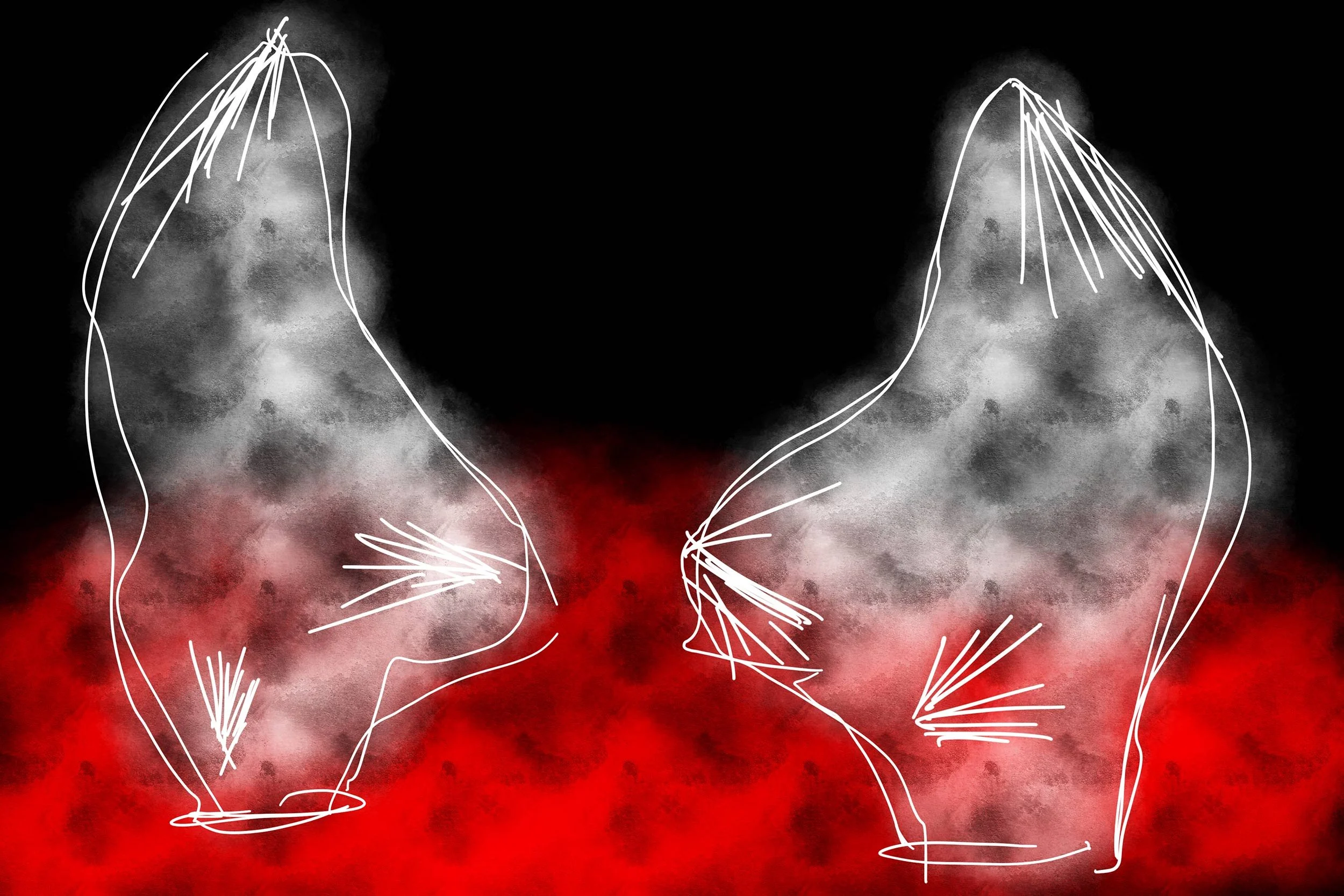
My sketch of Jean Arp’s Three Buds, 1957, seen from two sides. White marble, Los Angeles County Museum of Art (see the museum’s photographs)
A marble at the scale of the body
There is a white marble by Jean Arp that I have returned to for years, usually staying longer than I planned. It is called Three Buds, and it dates from 1957. It stands about twenty inches tall, close to the scale of a human torso. It belongs to the collection of the Los Angeles County Museum of Art.
Any sculpture, I think, faces the same quiet difficulty. Matter seems to be, at its core, change. Stone, as we perceive it, is not. So, how does one shape a still material so that it speaks of change?
Expecting a pair
The title does a good part of the work. Buds bring spring to mind, flowers, something just born. They are also sensual, and it is hard not to think of the body, of breasts, and so of a pair. We arrive expecting two.
We are given three. I suspect much of the sculpture's hold comes from that small displacement. Two would have been a symmetry, something already settled. Three seems to leave the form open.
Two plus one, wherever we stand
What I notice, walking around it, is that the three never quite appear as three equals. From almost any side there seem to be two, and one more rising from them. A step further, and the roles have changed: another bud has become the one that emerges, and the other two have become the pair.
The composition itself seems to turn with us. Its lower part is not symmetrical and leans upward to one side, and the top answers by curving the other way. The whole has the look of a gentle vortex, as if the marble had been caught in a slow rotation. It is a becoming that spins, very quietly.
So, no bud is the third. Each is the third of the other two. From a certain angle the two lower buds almost disappear. They lose their depth, and we understand that they are there mostly through the shadow they cast on the rest of the marble. These are soft shadows, with no sharp edge to them, closer to blurred regions than to darkness. The sensuality of the piece seems to live there, in the places where the form is least defined. After a while the counting itself begins to feel beside the point.
A humble link
I cannot look at this work without thinking of the philosopher D. G. Leahy (1937–2014). I should be careful here. Arp made these buds decades before Leahy published, and I am an architect and an artist with a beginner's grasp of a very demanding body of philosophical thinking. The connection exists only because both happened to settle in the same mind, mine, and my experience weighs no more than anyone else's.
Still, it is there. Ordinary logic, the kind everyday computers run on, has two values: one and zero, everything and nothing. Quantum computers already stray from that either-or, and Leahy himself saw his logic at work in quantum physics. Leahy's has three values, and none of them is nothing. His zero is "not nothing": not an empty quantity but something closer to the beginning of everything. Arp, a founder of Dada, would probably have liked the phrase. Beside zero stands a second term, something like possibility, and the two together give one, unity. Each of the three exists only through the other two, as the buds do. As I understand him, this leaves the old either-or behind, and what remains is matter itself, understood as change. When I read that, I see the marble. When I see the marble, I hear it again.
The whole, and the block
Many sculptures tell their change in sequence. They have a ground and a sky, a base, a body, a place where the form comes to an end. Brancusi's Bird in Space is perhaps the clearest case, a form we read from the foot upward to its final cut. Arp's buds seem to need none of that. The change is not narrated. It is all present at once, and we find it only by moving.
Perhaps this is why counting fails in front of it. We can find one bud, and then a pair, and we know a third must be somewhere among them. Yet what we actually see is none of these in turn. The parts blur into one another, and what remains before us is the whole, as if the third were not one more bud but the three of them, seen at once.
And if we stay with that blur a little longer, something else seems to happen. The whole loosens too. The blur becomes something like a vapor, a fine, granular veil with a soft but distinct outline, and for a moment the sculpture is almost a block of marble again, matter before it was carved. The shadow it casts on the surface where it rests seems to say the same. There the points of the buds are lost, and what remains is a soft, undefined mass, something like the block the marble once was, an image of Leahy’s zero. There is a kind of dying in this, but a gentle one, with nothing dark about it. Arp himself called works like this concretions, and spoke of sculpture as something that grows the way nature does, as a fruit grows on a plant. Perhaps this quiet return to matter is part of what he was after.
Then the points do their work. The buds are, after all, pointed things, and their tips seem to pierce that veil the way one bursts a bubble. The vapor gives, and the form springs back. The buds return, and it is new. The stone has not moved. It has only, in front of our eyes, begun again.
On Leahy, see D. G. Leahy and the Thinking Now Occurring, edited by Lissa McCullough and Elliot R. Wolfson (State University of New York Press, 2021), and his own website, dgleahy.com.
On the sculpture, see the photographs at the Los Angeles County Museum of Art.