
Brancusi's bird, read from the ground up.
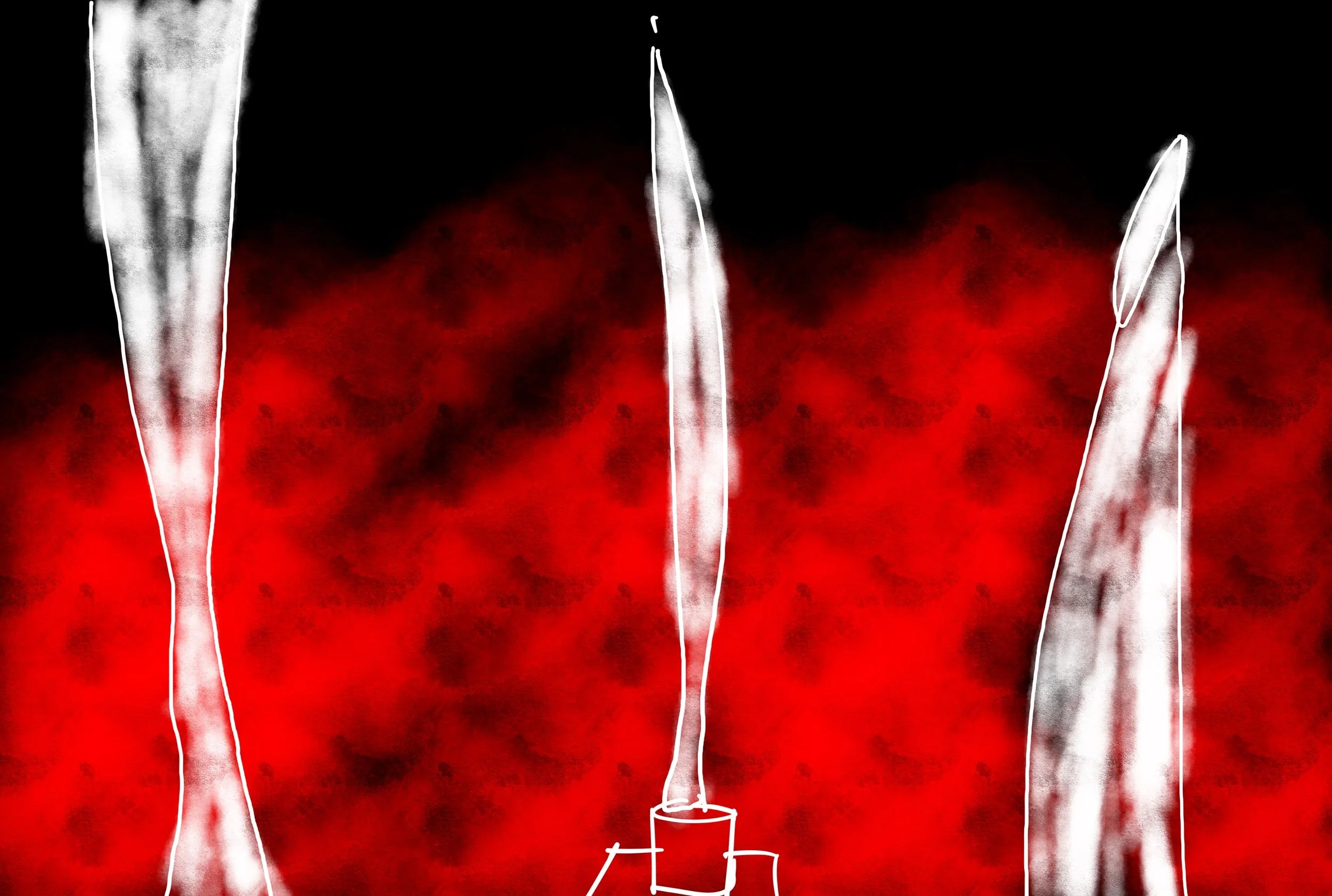
My studies of Constantin Brancusi's Bird in Space, 1927, cast later: the pinch, the whole on its base, the cut. Polished bronze, Los Angeles County Museum of Art (see the museum’s photographs).
Two realms
A bird seems to belong to at least two realms, the earth and the sky, and to be at ease in both. Yet it is meant to fly, and it flies only once it has stopped being a creature of the ground. I have often wondered about the task Constantin Brancusi set himself with Bird in Space: a single form that would hold two states at once.
Brancusi made sixteen versions of Bird in Space, in bronze and in marble. Two are at the Los Angeles County Museum of Art, and a bronze from 1931 is at the Norton Simon Museum in Pasadena. I have visited them many times over the years. Each time, the form reads to me less as a bird than as a still of the instant between the two states. A metamorphosis, held in polished bronze. I have come to think of the title, quietly, as Birth in Space.
How it meets the ground
Architects have a name for the place where a building touches the earth, and another for the place where it stops against the sky. In Italian, attacco a terra and coronamento. Most of the difficulty of a work, built or sculpted, seems to gather at those two ends. So I tend to read this one from the bottom.
First there is a cylinder of stone. It is neutral and asks for little attention. It seems to want to be only a transition, the world handing over to the work, something like an introduction to what is about to happen.
Brancusi cared about that transition. He wanted his Birds raised so that we look up at them, and he made their bases and pedestals himself. The one in Pasadena first belonged to a maharaja, who had asked Brancusi to design a Temple of Love, where the midday sun would fall on the bronze through a round opening in the ceiling. The temple was never built, and the bird's original stone cylinder stayed behind in India and is lost. Today it stands on a tall pedestal under the museum's circular skylight, and beneath it a base isolation system lets the ground move in an earthquake while the bird stays nearly still. Here, the handover from the world to the work has to be engineered.
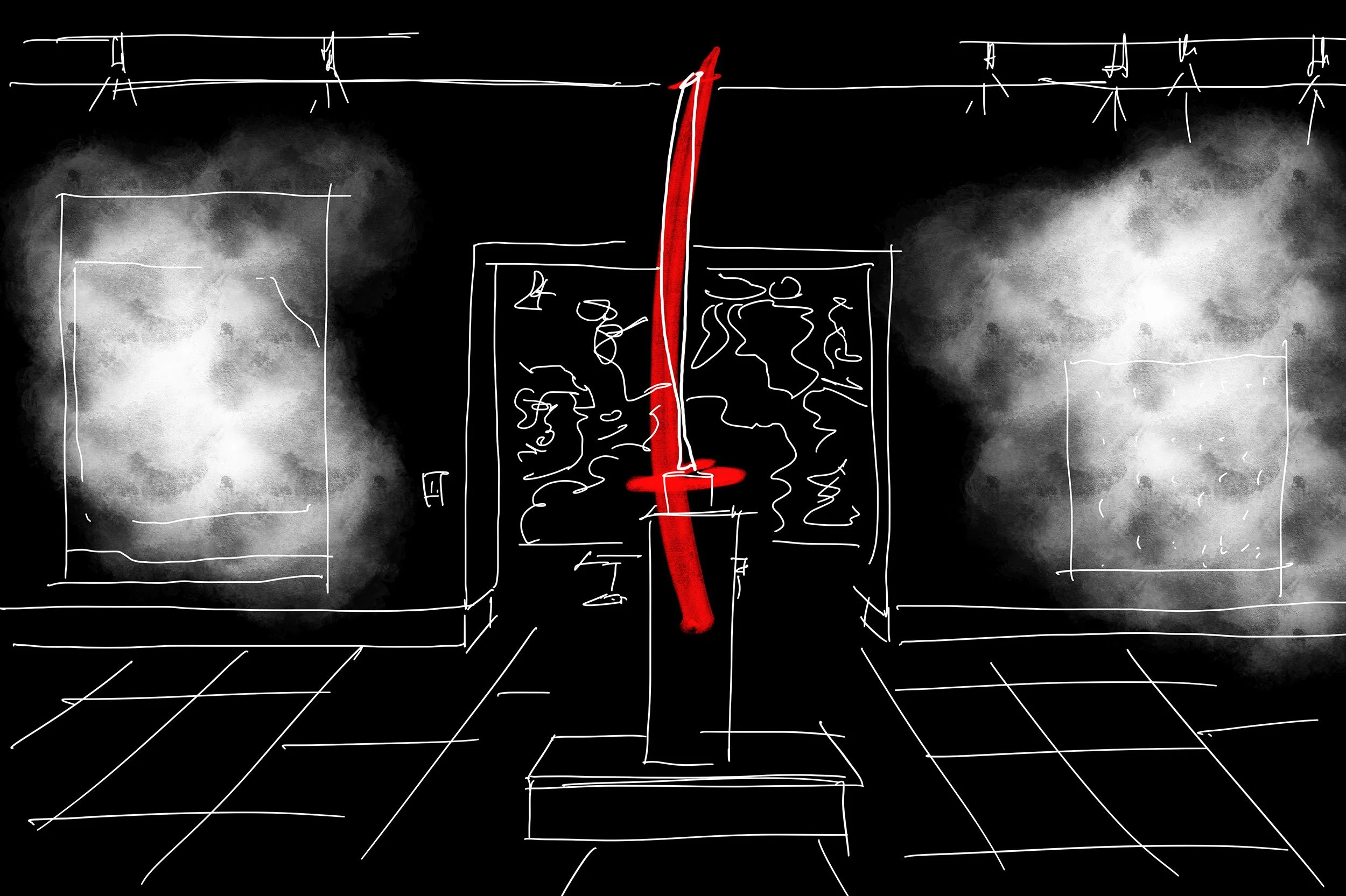
My sketch of Constantin Brancusi's Bird in Space, 1931, in its gallery at the Norton Simon Museum, Pasadena. Polished bronze.
Above the stone, the bronze begins almost awkwardly. A few short curves follow one another in a syncopated rhythm, a foot more than a wing, still loyal to the ground. The impression has a history behind it. Brancusi's birds began years earlier with the Maiastra, a miraculous bird of Romanian folklore, standing on its legs, and this footing is what remains of them. Nature, at this point, looks a little graceless, as if straining toward something. Then the form narrows to a pinch.
Two lines
After the pinch the composition relaxes, and this is where the change of state seems to happen. From where I usually stand, one edge rises almost straight. The other answers with a gentle curve that is never quite constant. The whole body of the bird is the tension between those two lines.
Walking around it, the straight line migrates, and the curve takes its place. The form will not hold still, which may be the point. The polish helps, of course. The bronze borrows the room and gives up its weight. But the reflection is the part that explains itself. What stays with me is that first decision, an almost straight line set against a curve.
How it stops
Followed far enough, two such lines would meet. Brancusi does not let them. The form ends in an abrupt, oblique cut, something like the stroke of a machete. In the earlier birds this was a beak, open as if singing. Over the years the mouth seems to have become a cut, and the song is ours to hum. We see the cross-section, and we also see what is not there: the rest of the flight, completed in the mind.
It reads to me as his answer to an old problem, for the artisan as much as for the artist. A sculpture has to end somewhere, and this one manages to end while remaining indeterminate. The Endless Column appears to make a similar move, a rhythm that could go on and is simply interrupted. There is perhaps something of life and its limit in that cut, though the work does not insist on it.
A talisman
An obscure, almost undeveloped start above the stone. Two lines in tension. A sudden cut. I find it hard to think of a clearer lesson in how matter can rise from the ground and take leave of it.
I consider this work a talisman. I return to it to be reminded of what a form can do with so few moves, each one inevitable, as if dictated rather than chosen.
On the sculptures, see the photographs at the Los Angeles County Museum of Art and the Norton Simon Museum.
On the Pasadena bird, see John Griswold, "Brancusi's Bird in Space Soars Again," Norton Simon Museum, 2020.
On the Maiastra, see Brancusi's Maiastra, about 1912, at the Peggy Guggenheim Collection, Venice.