
Two doors in a single frame.
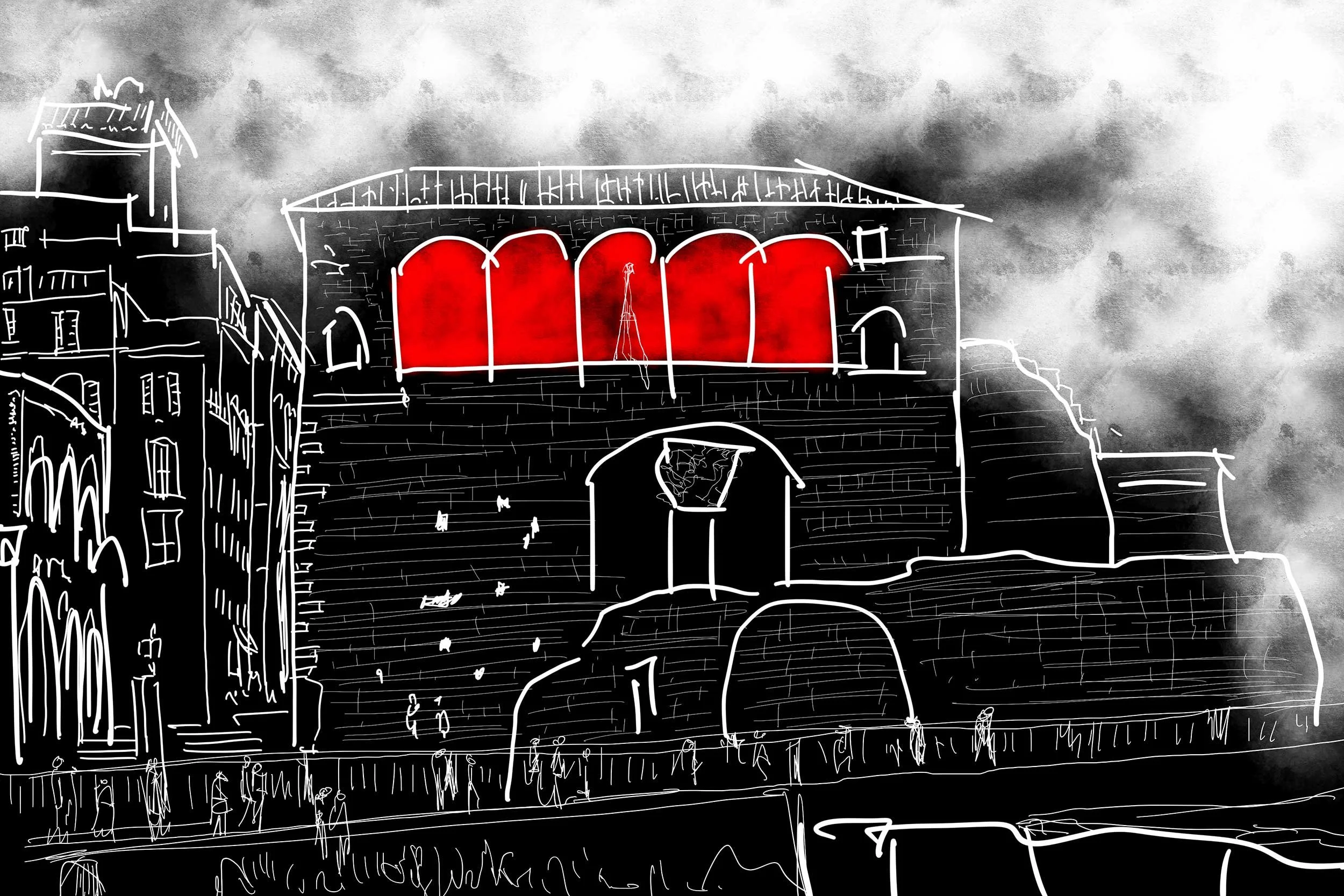
My sketch of the Casa dei Cavalieri di Rodi seen from the Forum, with the loggia above the Roman walls.
A loggia above the Forum
As a student in Rome I took classes not far from Via dei Fori Imperiali, a short walk from the Casa dei Cavalieri di Rodi. On the short wall of its Renaissance loggia there are two doors, side by side, sharing a single stone frame. In Italian we could call it a porta binata, a paired doorway, borrowing the adjective more often given to columns and windows that come in twos.
I no longer remember where the two doors lead. It may be one room or two. I find that I don't mind, and that the forgetting is perhaps part of what the pair does.
A wall, opened three ways
What strikes me now, looking at the loggia again, is that this one room seems to rehearse the different ways a wall can give way. Toward the city the wall dissolves into arcades, columns and air. Elsewhere it is painted: fictive pilasters frame a landscape, so the plaster pretends to be open while staying shut. And then, at the far end, the wall is actually pierced. Twice.
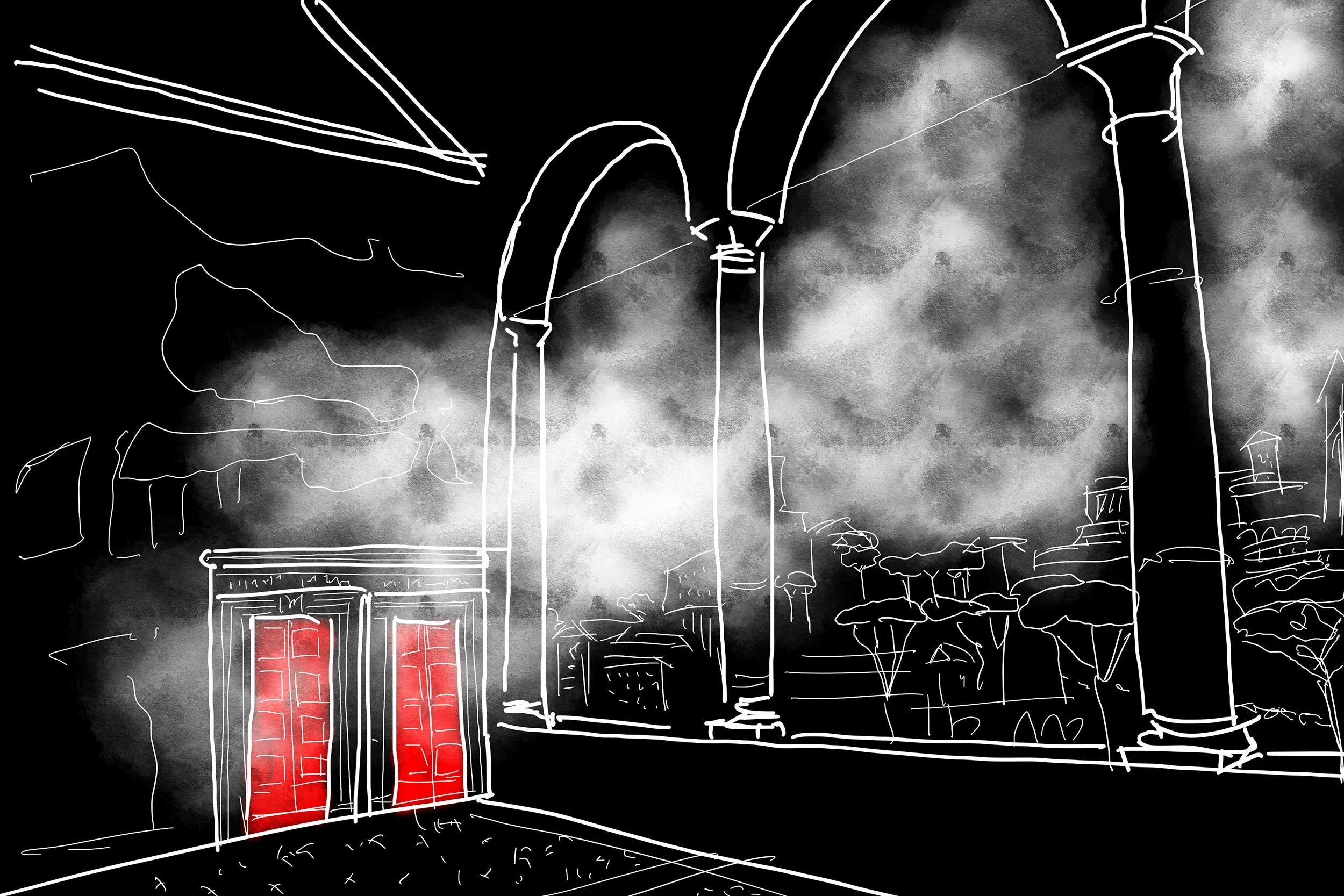
My sketch of the loggia: the arcade, the painted wall, and the porta binata.
There is a contradiction in every opening, and architecture tends to live with it quietly. We build a limit, and almost at once we have the problem of the impediment. We raise a continuous surface and then call on a lintel, a small feat of engineering, to interrupt it. A door is the place where a wall admits it was never meant to be complete.
The second door
At least two ways of putting two doors in a wall come to mind. A double door gives one opening two leaves, as at a front entrance or a fire exit. Two separate doors keep their distance, each on its own stretch of wall. The porta binata does neither. It sets two complete doors side by side under one frame, and the eye reads not one door divided but one door said twice. The pairing reads less as a solution than as a statement. Whoever arrives is handed two thresholds at once, left or right, with little to tell them apart.
Between the two openings a narrow jamb remains. It is the wall reduced to a post, still standing, still insisting on the limit while giving way on both sides. I think of it as the most extreme move of the composition.
An inscription above the pair records that Cardinal Marco Barbo restored the house under Pope Paul II, which dates the work to around 1470. The scholar Alessia Dessì links the doorway to the circle of Bernardo Rossellino and points to a near twin at Santo Stefano Rotondo. I leave the history to her. My interest is in what the pair asks of the person standing in front of it for the first time.
Duchamp's hinge
In 1927, in his Paris apartment at 11 rue Larrey, Marcel Duchamp hung a single door in a corner between two openings. Closing one opened the other. The door, in a sense, declined to decide.
The loggia does the reverse. Duchamp has one leaf and two openings, and the ambiguity sits in the object. Rome has two doors held in one frame, and the ambiguity moves into us. For a moment before choosing, we are not yet anywhere, in front of something like a veil of possibilities.
Passing through
Perhaps that is why crossing a threshold can still feel like a small ritual, a change of state. A window frames the outside for us and leaves us where we are. A door asks us to move. A paired door asks us to hesitate first, and I have come to think the hesitation is the architecture.
On the history of the Casa dei Cavalieri di Rodi, see Alessia Dessì, “La committenza Barbo nella Casa dei Cavalieri di Rodi,” BTA - Bollettino Telematico dell’Arte, n. 682, June 9, 2013, www.bta.it, file bta00682.html.
On the building today, see “La Casa dei Cavalieri di Rodi,” from the Italian Association of the Order of Malta.
On Duchamp’s door, see the photograph of the door in the 11, rue Larrey apartment, Marcel Duchamp Exhibition Records, Philadelphia Museum of Art.