LAB
Welcome to LAB
THE RESEARCH STUDIO OF STABILE ARCHITECTS
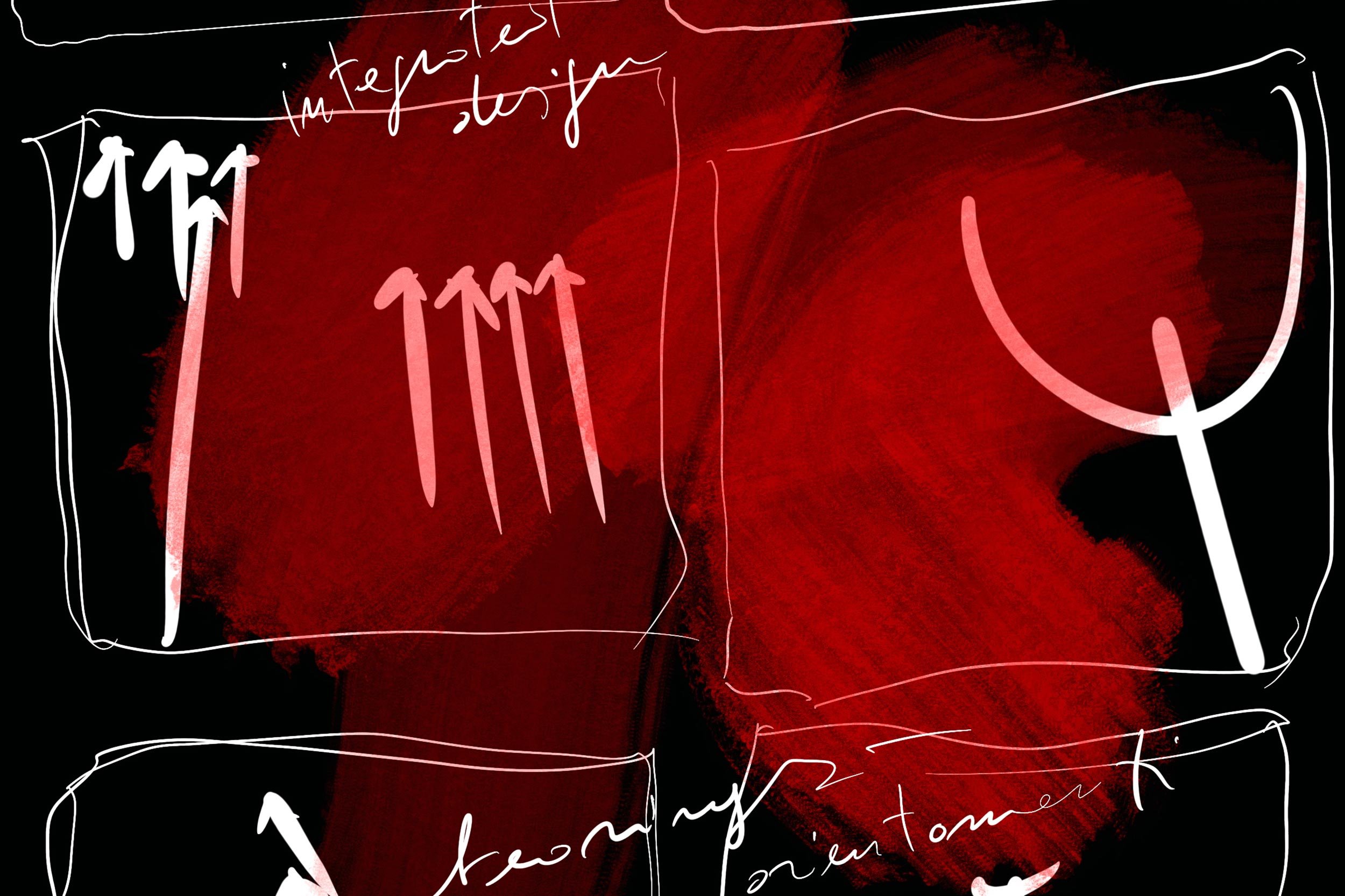
Integrated Design
In the last 15 years, while practicing architecture and construction, I made mine the Olivetti’s imperative according to which “production and esthetics, efficiency and design, rationality and beauty had to be aspects of the same composition.” In other words, integrated design and the fruitful process begetting it.
A design process of cross-pollination among all arts.
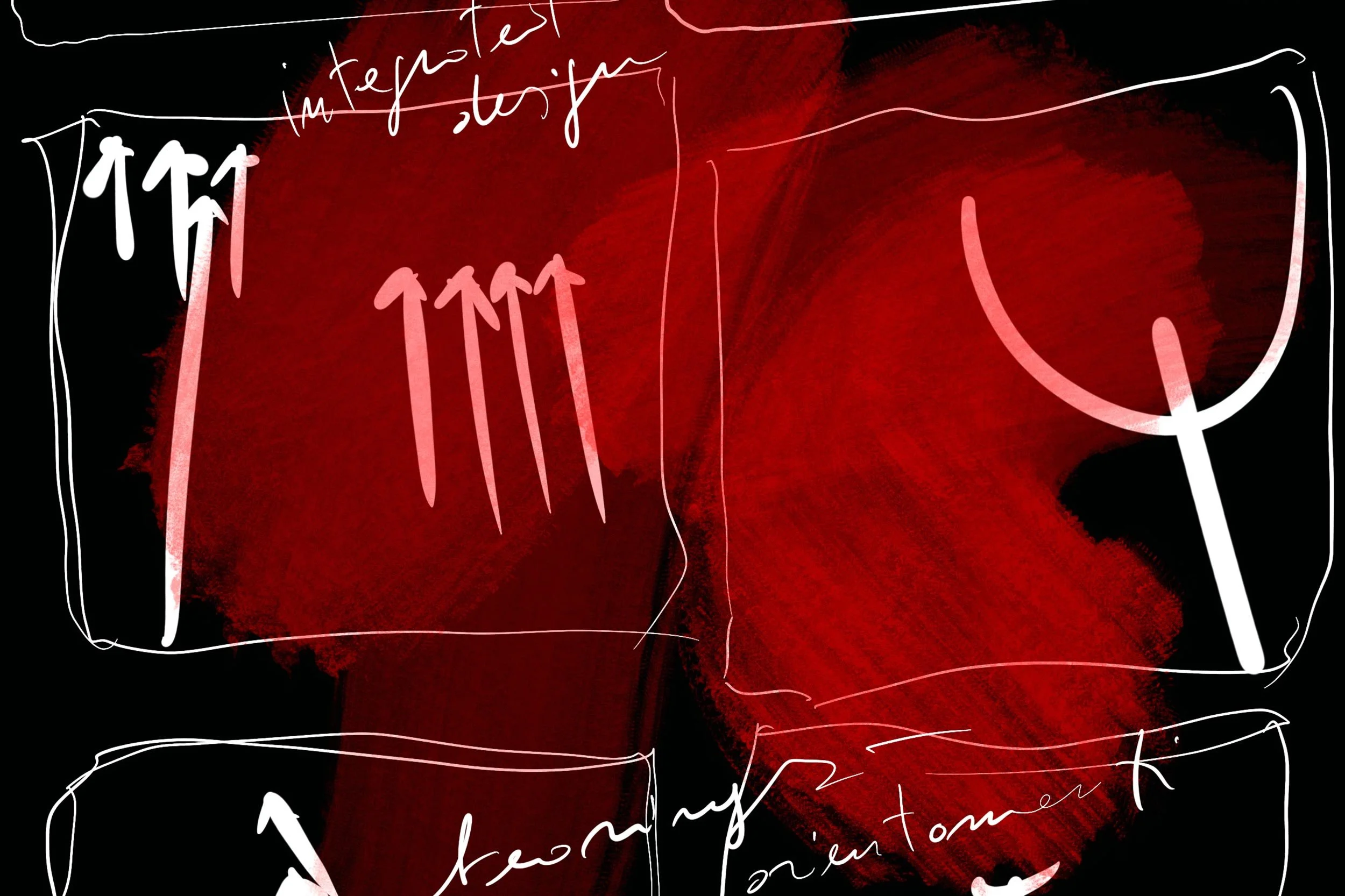
Bearings, ceramic panel: preparatory sketch
The special issue of the Museum of Modern Art’s bulletin companion to the exhibition Olivetti: Design in Industry, October-November 1952, on page three articulates the underpinning concept of integrated design, “It is the purpose of this exhibition and bulletin to encourage our industries in the battle for good integrated design by illustrating the excellence of the Olivetti program. Not only is it pleasanter to write on a beautiful typewriter, not only is it pleasant for employees to work in a handsomely designed factory and live in well-designed housing, but it cannot fail to be profitable in many ways, even perhaps in terms of money, to present all the visual aspects of an industry so that they become […] a trademark to the world.”
The Olivetti Design Process: A Legacy of Integrated Architecture
The 1979 UCLA Olivetti Exhibition
In March 1979, Olivetti was the subject of another exhibition. This time in Los Angeles at the Frederick S. Wight Art Gallery at the University of California (UCLA). Curated by Nathan H. Shapira the exhibition was titled Design Process. Olivetti 1908-1978.
Because of the anthological nature of the exhibition—coinciding with the closing chapter of the Olivetti pioneering research—Shapira could further clarifies the concept of integrated design by illustrating how integration is only possible through a very peculiar design process of cross-pollination among all arts.
In fact, as he points out “This exhibit looked at Olivetti as a renaissance contemporary company in historical perspective. This exhibition recognized that Italian industry really carried on the legacy, history and tradition of the Italian arts, sciences and production. This creative legacy personified and distinguished Italian design ingenuity and manufacturing in a unique manner. In this manner, Italian art and design personified a harmonious linkage between visual expression, creativity and utility. This was personified through a poetic romanticism between art, form, and function.”
From Arcosanti to Contemporary Integrated Architecture
As a Rome-based young architect propelled by these same ideals, in 2007 I worked in the planning department of architect Paolo Soleri’s urban laboratory Arcosanti (in northern Arizona), exploring the conviction that architecture is a practice incorporating all the fundamental spheres of living
In the last 15 years, while practicing architecture and construction, I made mine the Olivetti’s imperative according to which “production and esthetics, efficiency and design, rationality and beauty had to be aspects of the same composition.” In other words, integrated design and the fruitful process begetting it.
I think and lead STABILE architecture | construction with the assumption that every architecture firm is an all-encompassing system of social and cultural values. Despite the many compromises that each project inevitably demands due to the specific socioeconomic context that—nevertheless—makes it possible, our daily practice is guided by Olivetti’s definition of culture “culture in its authentic meaning of the disinterested pursuit of truth and beauty.” Culture is not a mare uniformity of style but a practice-wide awareness—from the first sketch to erecting the structure to the client moving-in—of the cultural responsibility as architects forging designs that implement Earth’s finite resources.
Inspired by Olivetti’s Integrated Design and Shapira’s concept of “a poetic romanticism between art, form, and function”, at STABILE architecture | construction we approach each design holistically. Any project idiosyncrasy is the opportunity to create episodes of beauty. Moving through space is spiritual, and making good design is a testament to it. That is why I decided to develop a series of ceramic murals that could partition, like veils, open floorplan spaces or—when thought of as murals—amplify the surface of the architectural volume.
I first experienced the synergy of clay art and architecture while working with architect Paolo Soleri at his urban laboratory of Arcosanti (in northern Arizona high desert, two photos below)—Soleri worked for Frank Lloyd Wright in the late 1940s and received important acknowledgments over the span of his career including an AIA Gold Medal, the Venice Biennale’s Golden Lion, and the Smithsonian Medal for Lifetime Achievement.
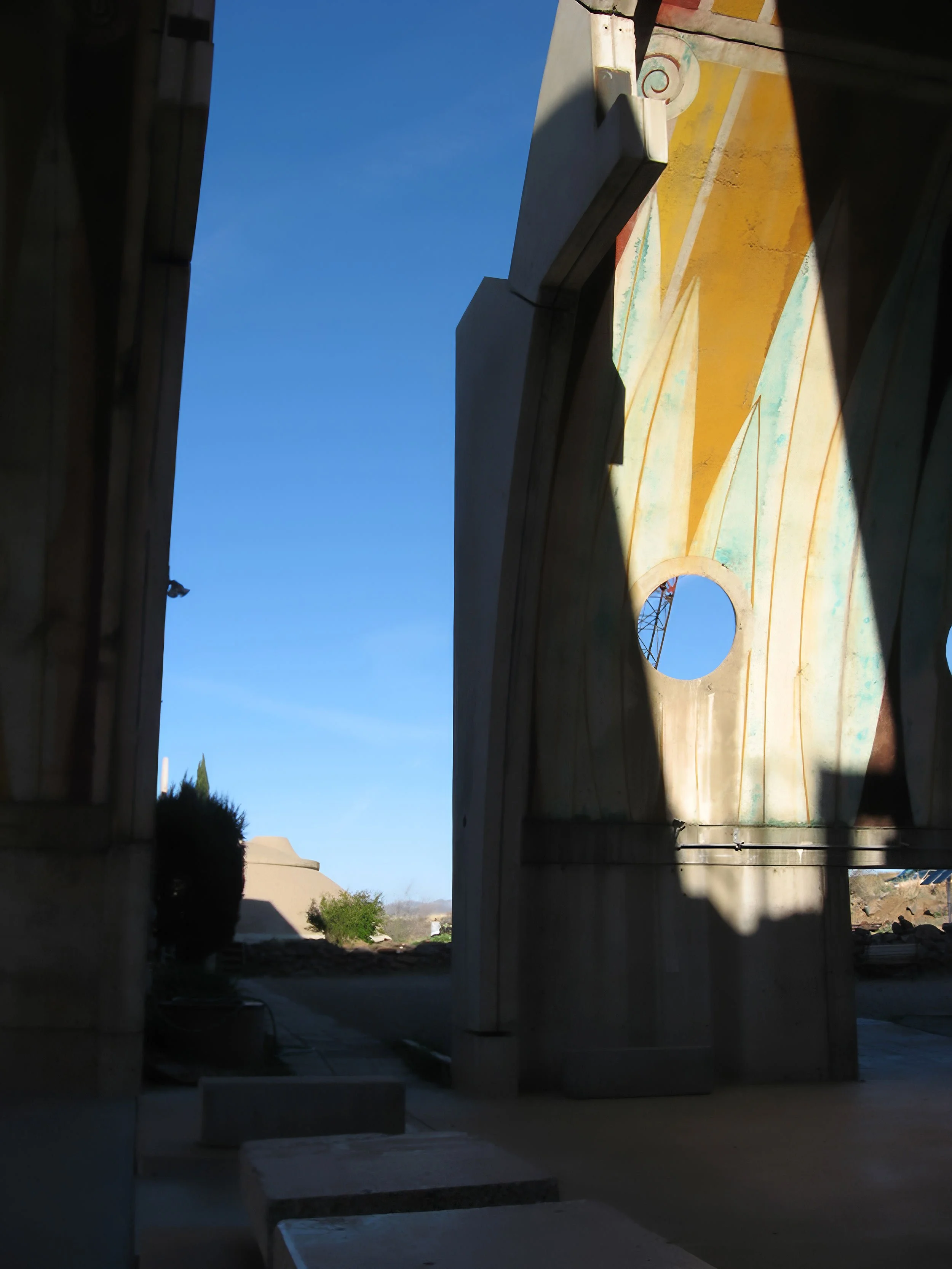
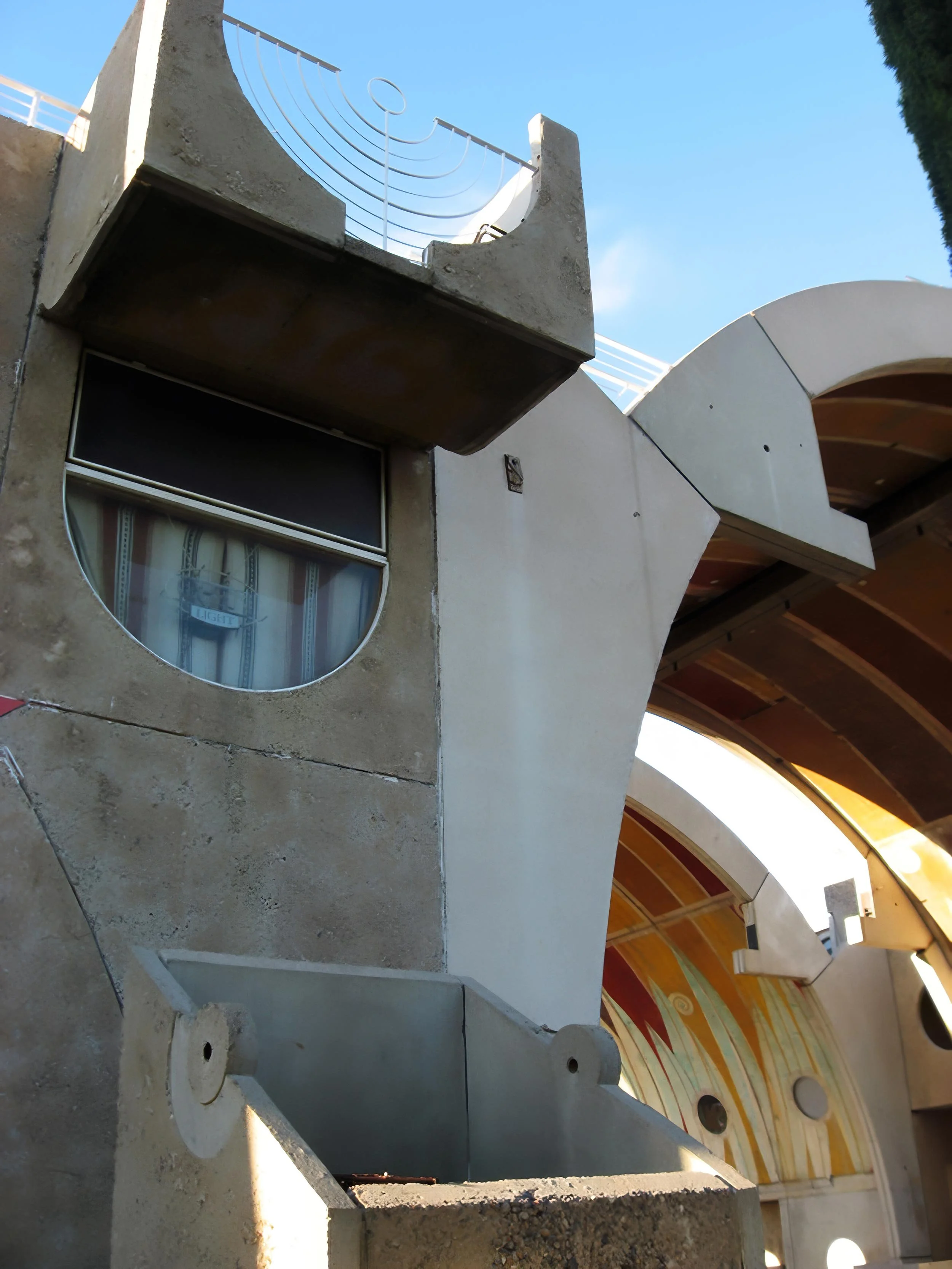
Morphing a wall in a poli-dimensional presence
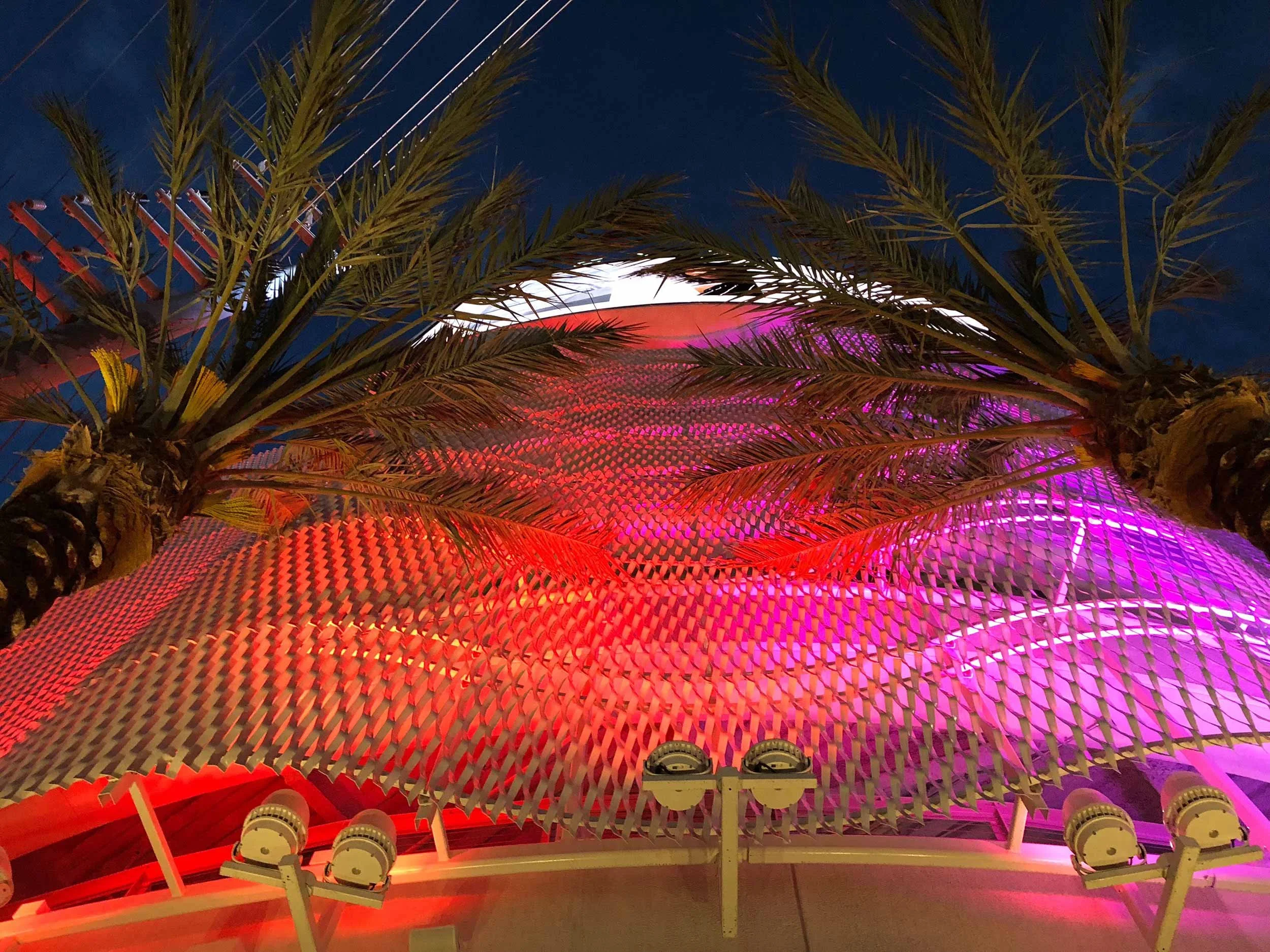
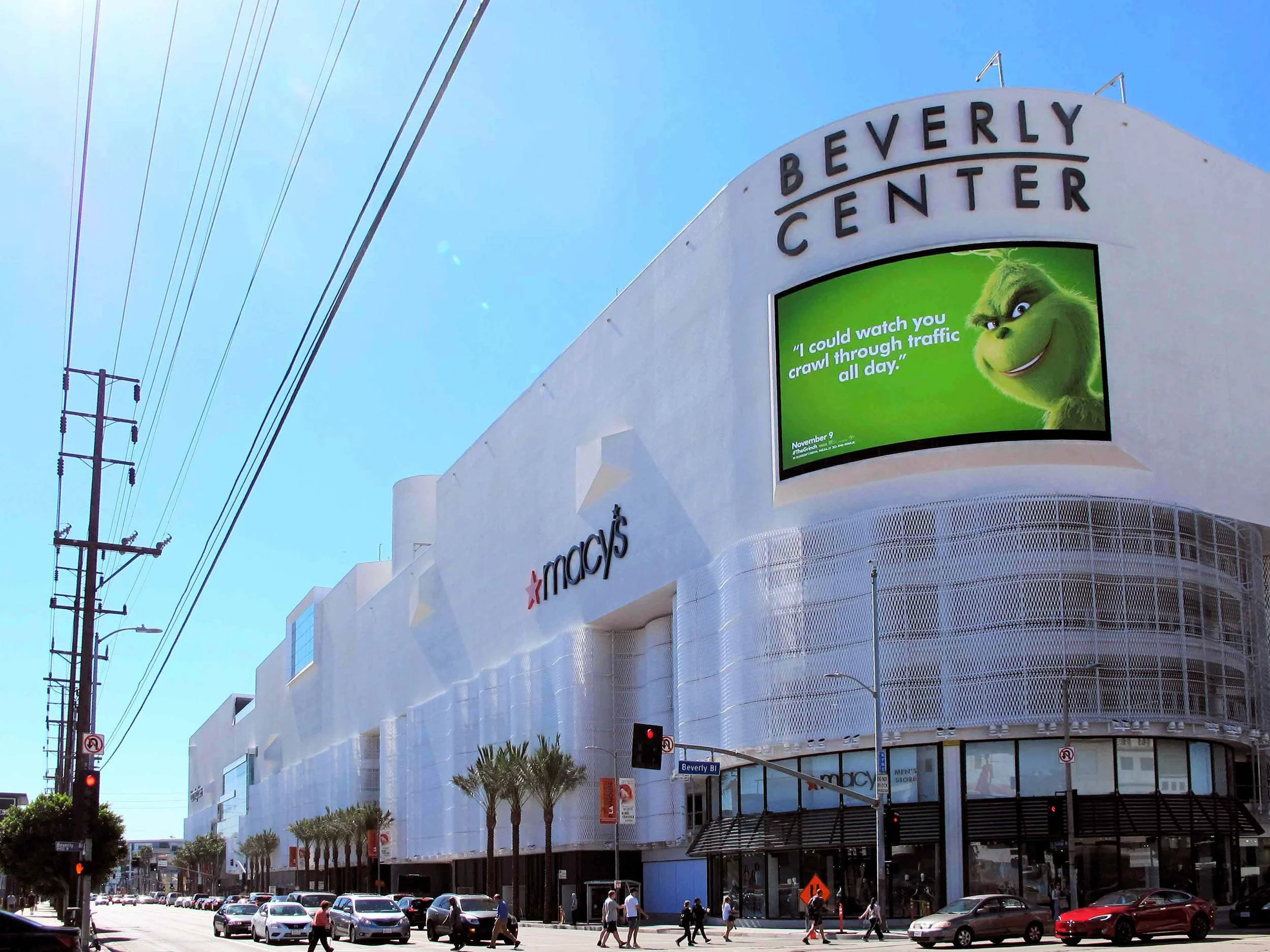
But the idea of morphing a wall in a poli-dimensional presence is also in full continuity of spirit with the metal mesh wrapping the West Hollywood adjacent Beverly Center shopping mall, two photos below. The polyhedric metal mesh was part of the Studio Fuksas design for the mall 500-million refurbishment to which I had the honor to contribute as architect and project manager until its commissioning in January 2019. Studio Fuksas—Commandeur de l’Ordre des Arts et des Lettres de la République Française, Honorary Fellowship of the AIA and RIBA—turned the 800-feet-long and eight-story-high La Cienega Boulevard elevation in a dynamic experience by implementing a mesh that throughout the day, with its organic curves and diamond-pattern, reacts to natural light and artificial lighting in unexpected ways aerifying the otherwise over imposing architectural mass of the 886,000 square feet mall.
Precedents
Other precedents of Integrated Design close to my heart are Matisse’s ceramic panel La Gerbe (The Sheaf)—bequeathed to LACMA and commissioned by Mr. and Mrs. Sidney F. Brody in the early 1950s for the courtyard of their residence in Beverly Hills by architect A. Quincy Jones—Nivola’s 1954 wall relief for the Olivetti showroom on Fifth Avenue in New York, and Bitters’s beloved Californian ceramic murals—one of which was recently installed on the valet walls of Columbia Square Living, a few blocks away from our studio in Hollywood.
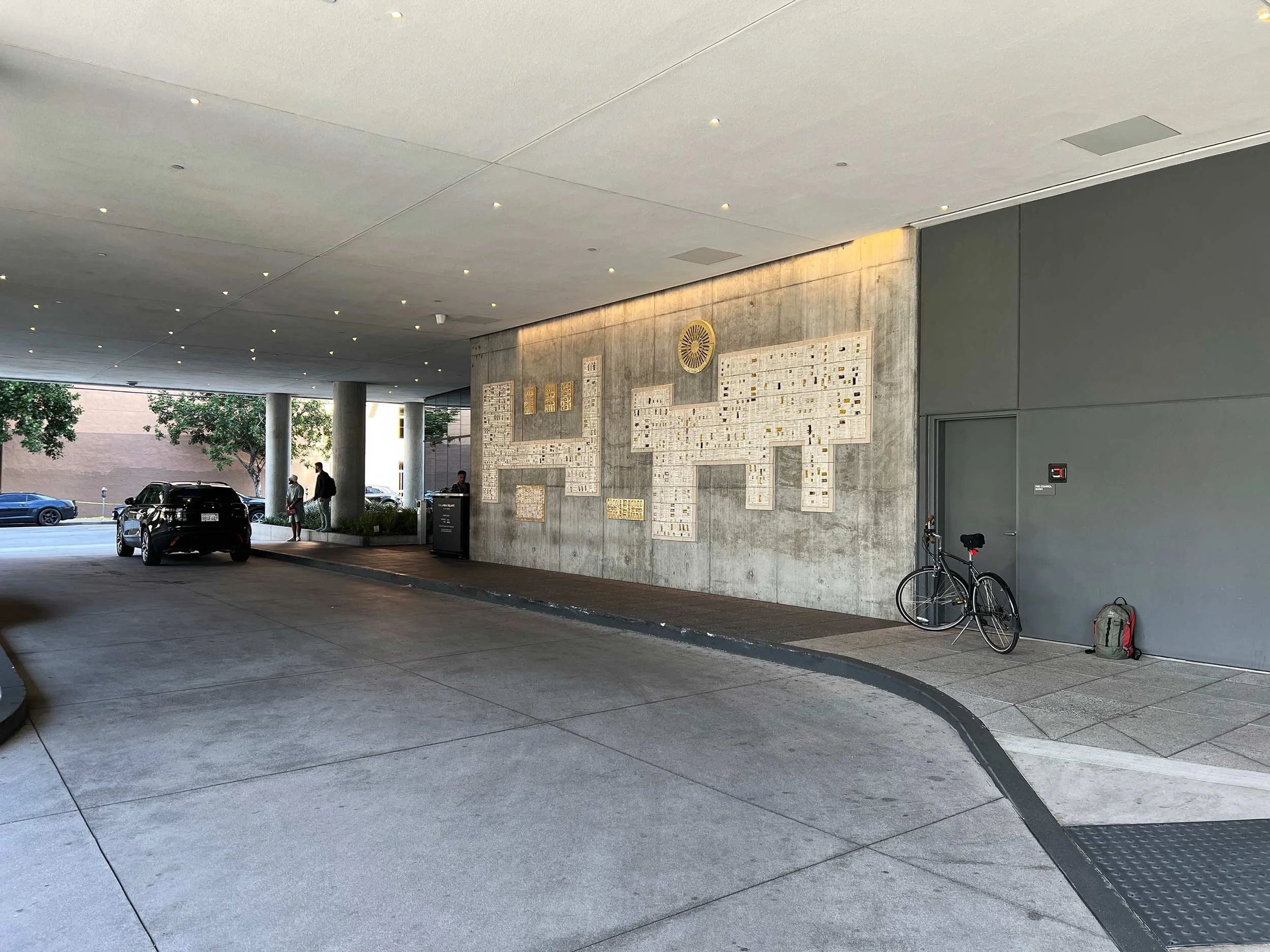
Bitters, Columbia Square Living, Los Angeles, California
Bearings, a clay mural
Bearings is the first of the clay mural / veil series by STABILE architecture | construction. It measures 53.5 inches in height and 54.75 inches in width. It is an assembly of eighty-one blue-engobe clay tablets. The work invites meditation on how the body orients itself in space. Bearings opens to the multiplicity of directions and choices. The blank clay slabs act as seismographic registers recording field forces, compression, and rarefaction in three-dimensional spaces behaving as two-dimensional. The everchanging relationships between three prime elements – Y, Arrow, and Blue Engobe – inform and orient each clay tablet face one after the other. Through repetition and seriality, the viewer intuits a transition from signs to symbols to language.
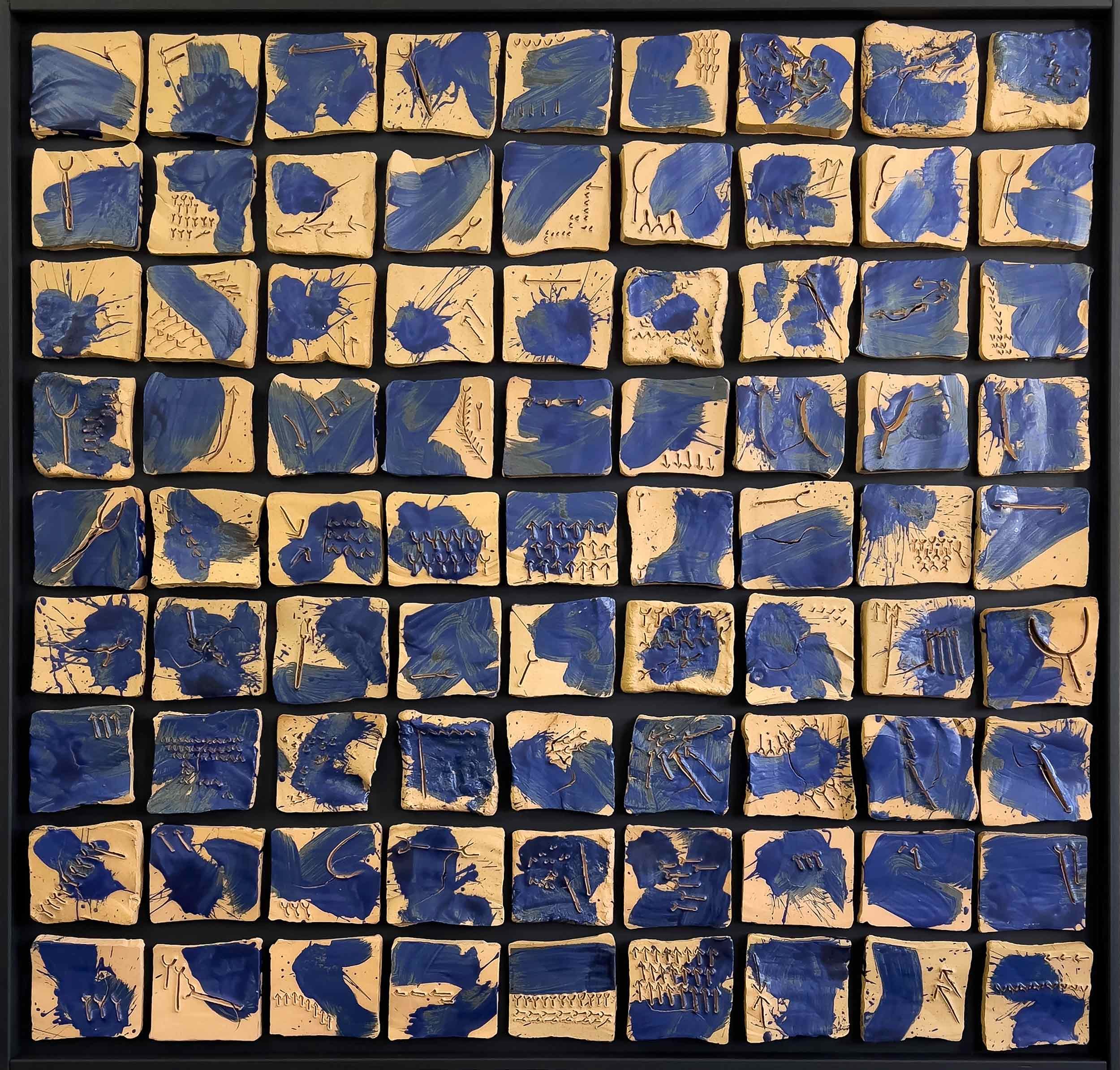
Above: Stabile, Bearings, clay mural. Below, details
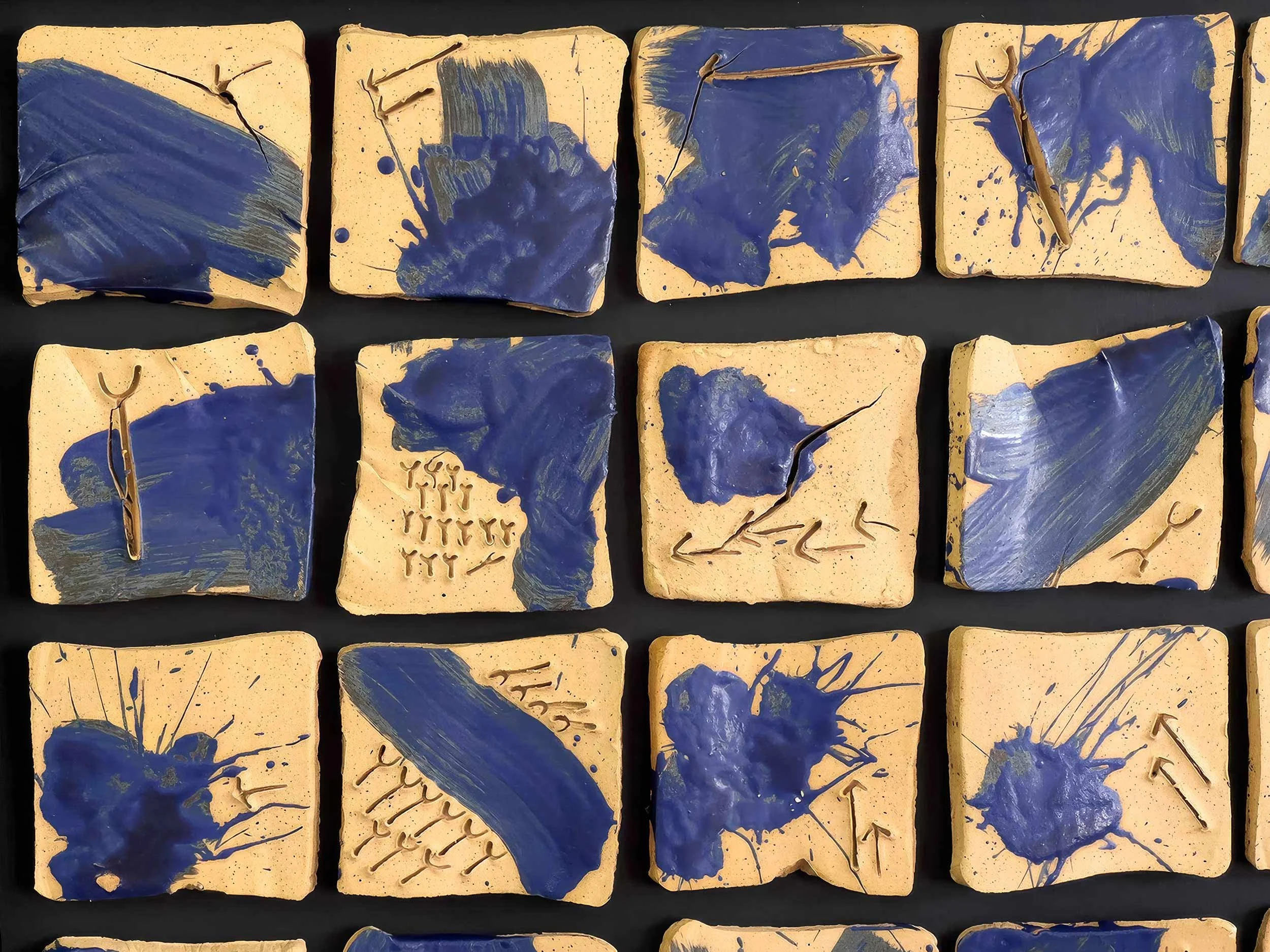
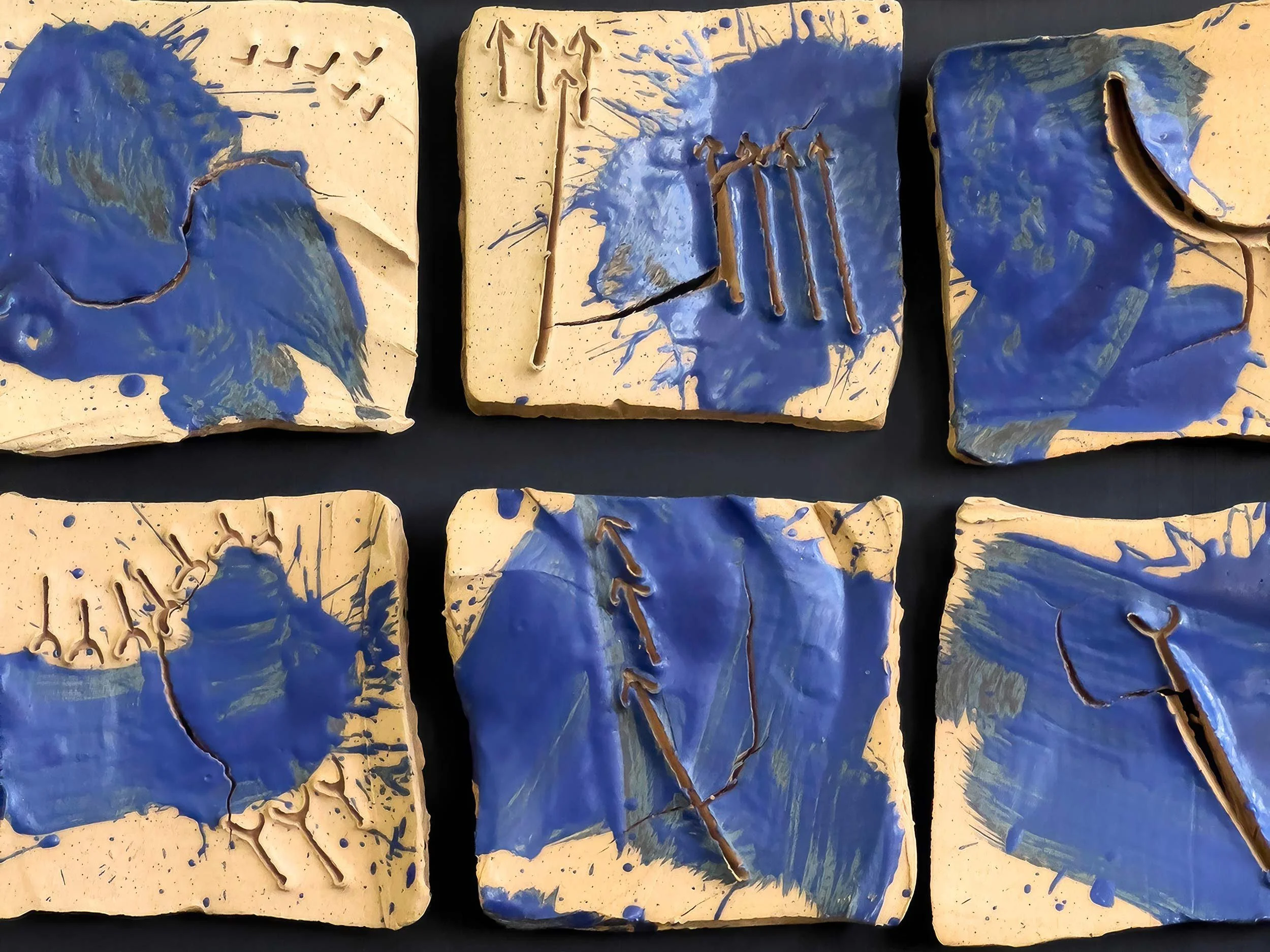
The clay murals / veils are not meant as decoration but as integral and essential part of the architectural space. Paying homage to the mid-century architecture concept of authenticity of material and inherent beauty of its texture, the registering surface of each tablet with its specific materiality and sense of urgency is the essence of the work and its substance, eliminating the need for any other interpretation. Each tablet displays structural elements of the conditions of contemporary architecture such as “mutability, temporariness, contradiction, and love for the detail,” to quote art critic Bonito Oliva on occasion of the 2008 exhibit La Mano Decapitata.
The series of collages below demonstrate how ceramic mural Bearings could interact with different architectural contexts. There is the classical setting of Villa San Michele in Capri (Italy) built in 1895 by Swedish physician Axel Munthe as a modern version of a domus from Roman times. Then, we experimented with the setting of the Schindler House (1921-22, West Hollywood, California), the first modern house designed by Viennese architect Schindler for the specific Californian climate and served also as a prototype for Modernist residential design for decades. Finally, we set Bearings in the context of two contemporary residences we recently completed in Los Angeles, a few miles away from the Schindler House.
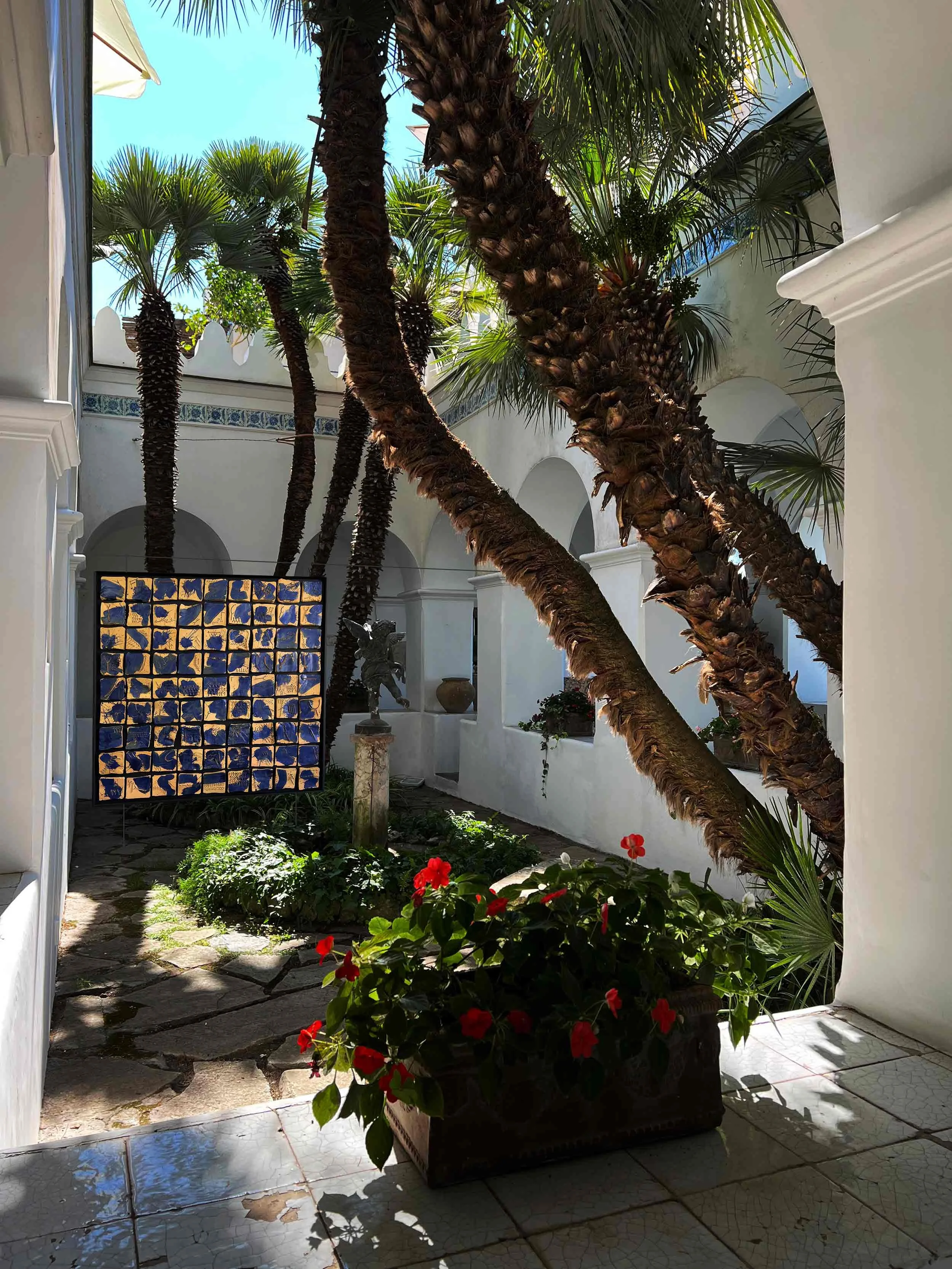
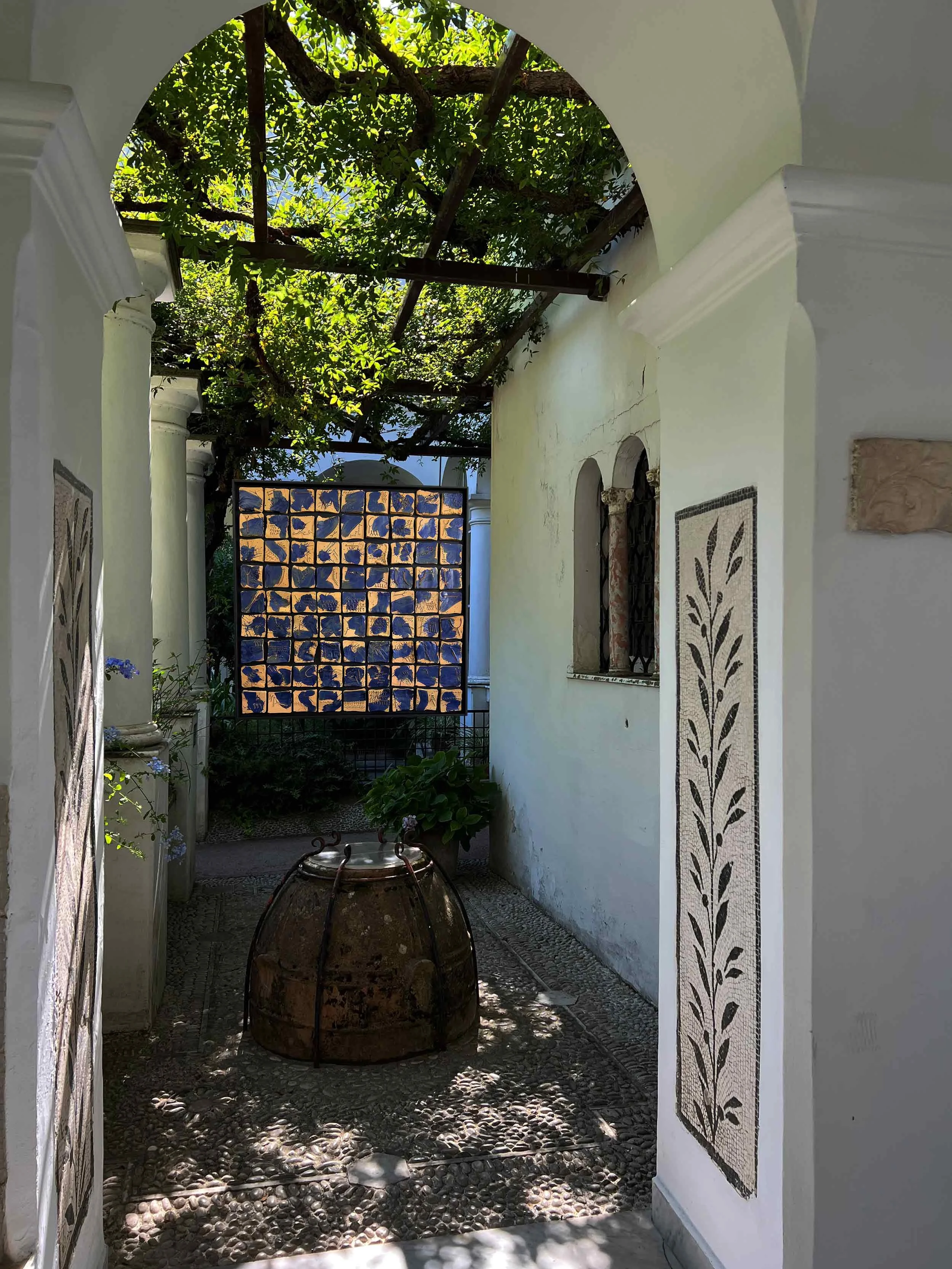
Above: photomontage, Bearings (clay panel) at Villa San Michele, Capri, Italy
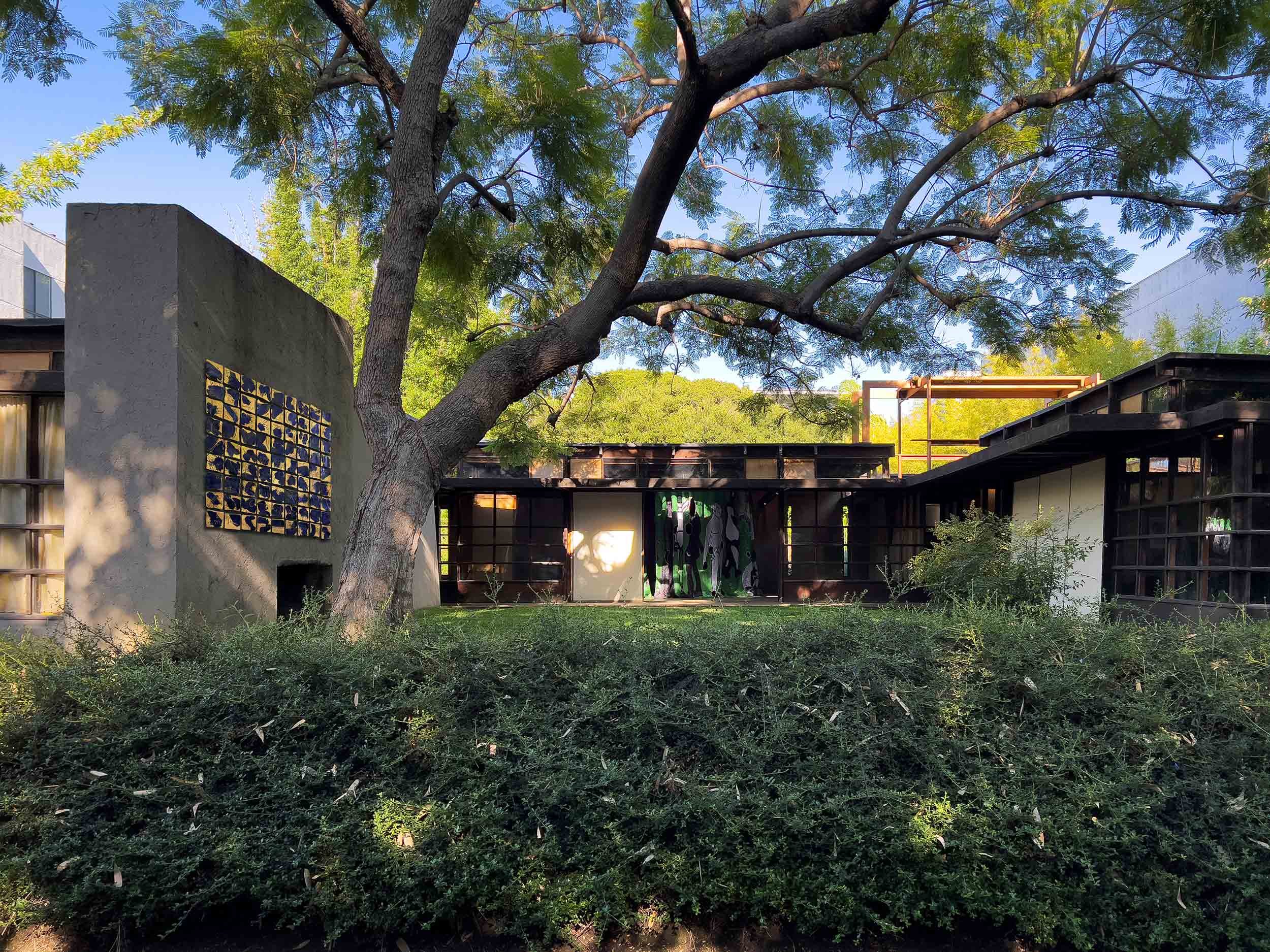
Photomontage, Bearings (clay panel) at Schindler House, Los Angeles, California
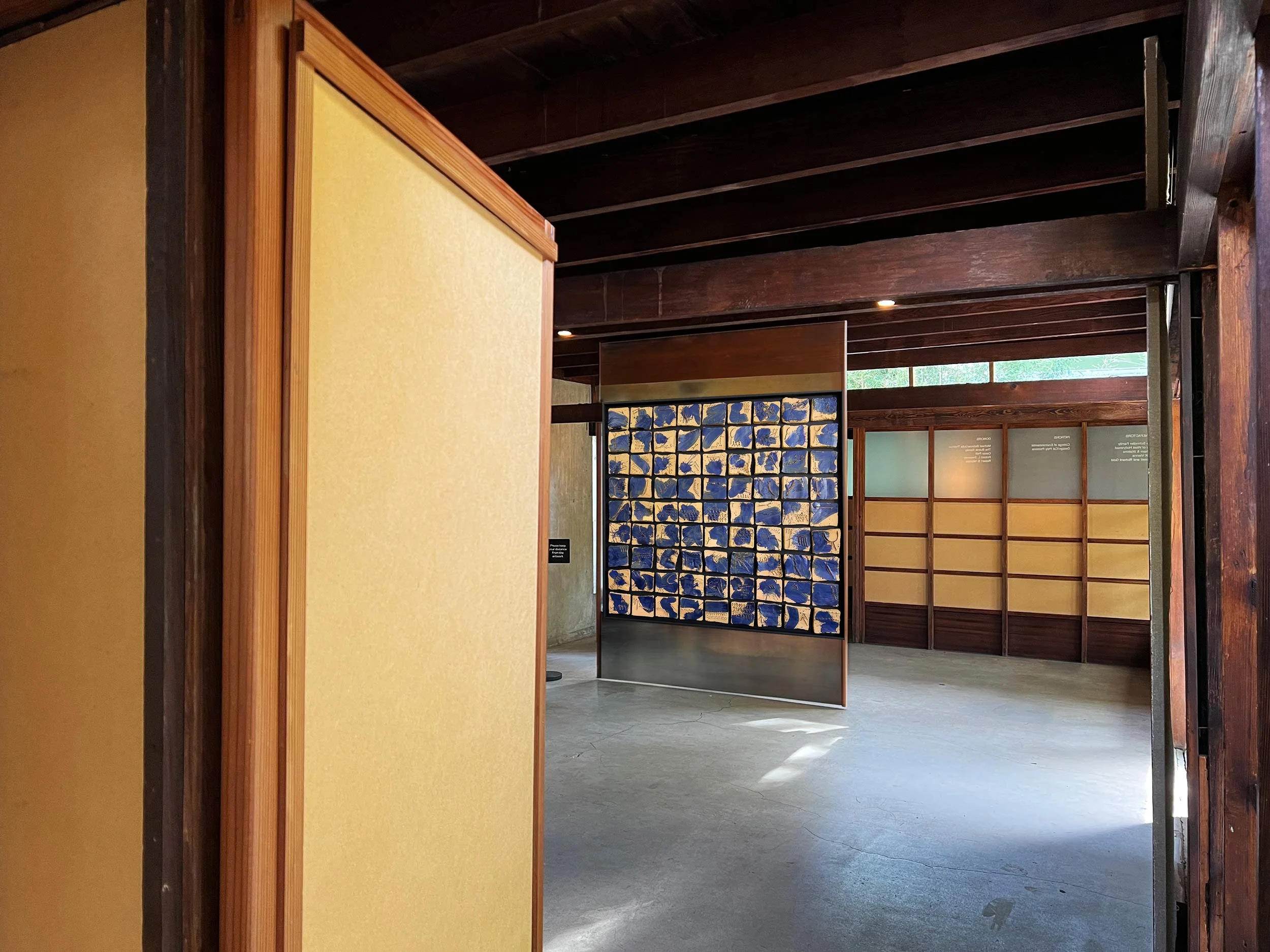
Photomontage, Bearings (clay panel) at Schindler House, Los Angeles, California
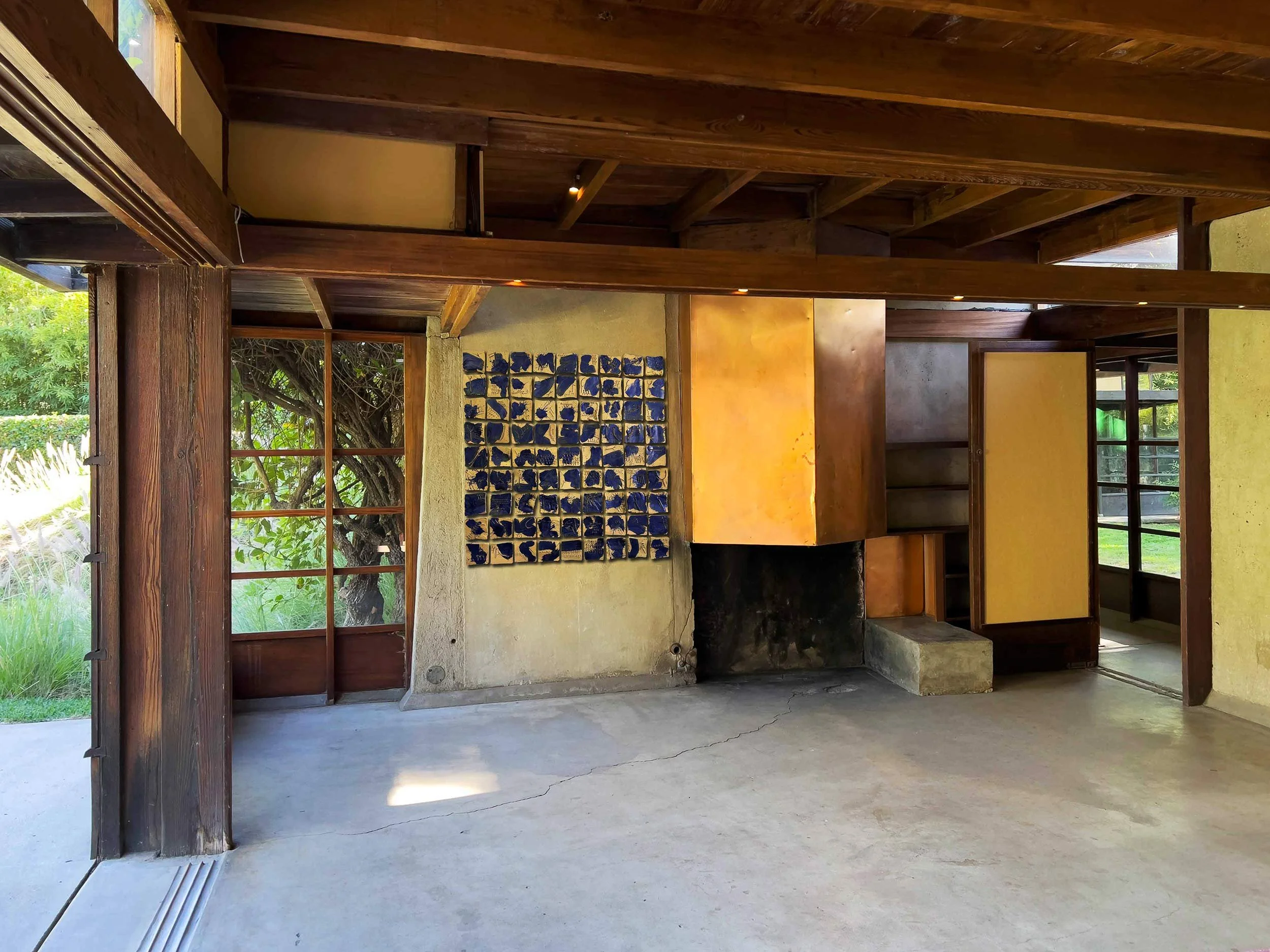
Photomontage, Bearings (clay panel) at Schindler House, Los Angeles, California
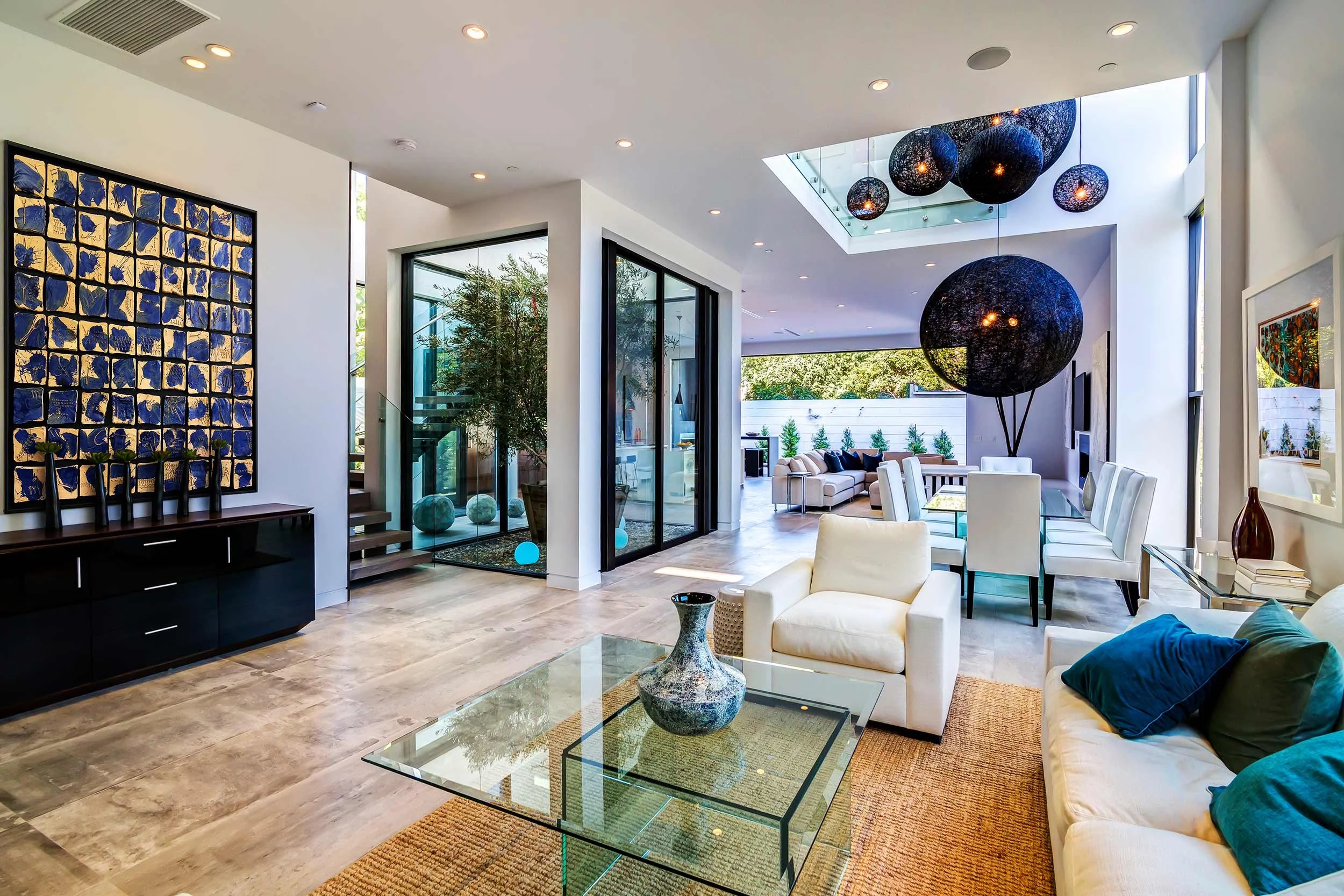
Photomontage, Bearings (clay panel) at the Mansfield residence, Los Angeles, California
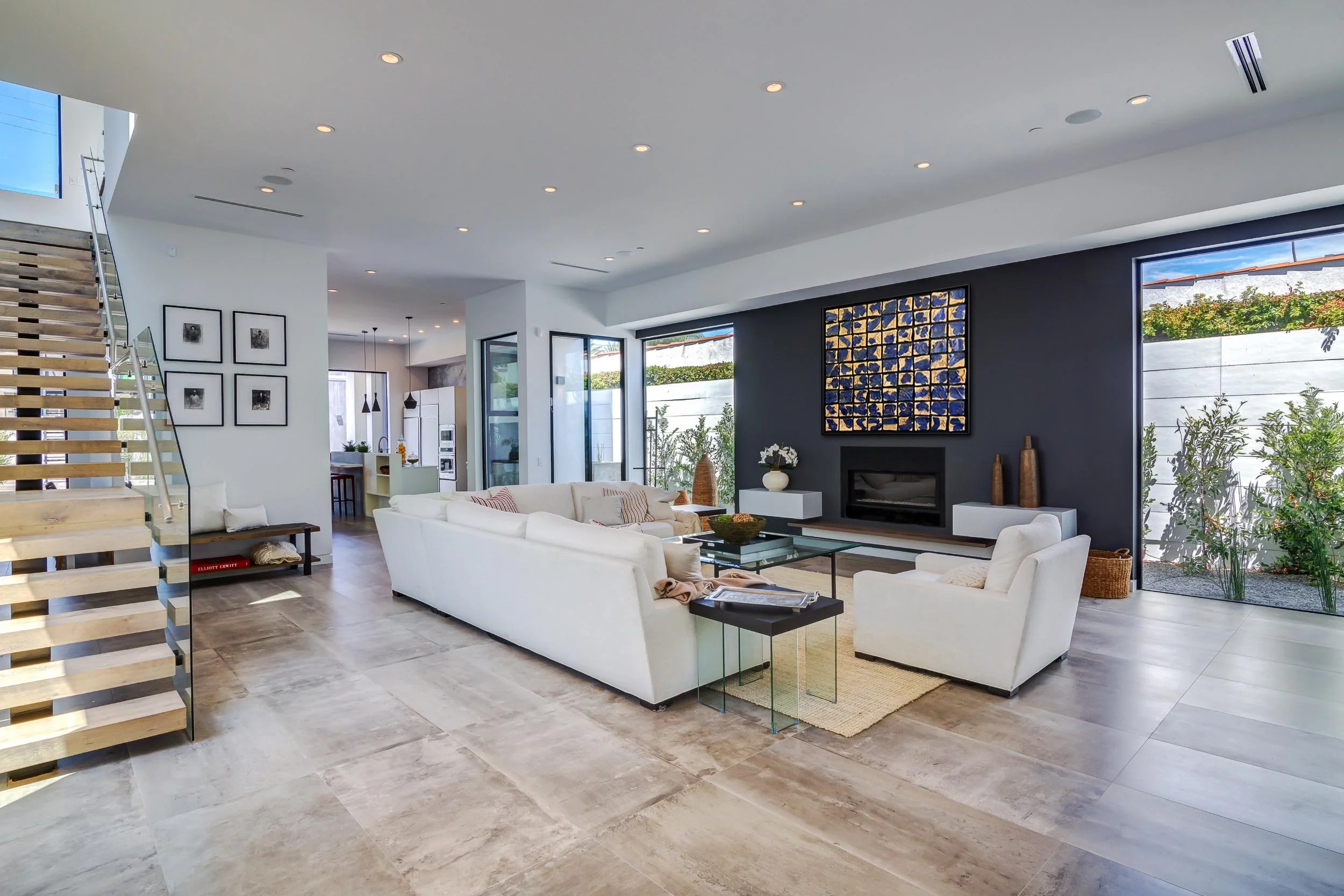
Photomontage, Bearings (clay panel) at the McCadden residence, Los Angeles, California
Meticulousness and artisanal results
The specific amount of grog added to the clay mix to improve its texture, strength, and stability, the peculiar pattern left behind by the metal wire used to slice the raw clay, the rare hue of matte blue engobe, the raw and organic shape of each tablet and the specific gaps between them, the custom 15 mm Baltic birch plywood and the structural screw-pattern of the framed version of the mural for which a CAD layout was produced, are all peculiarities testament to the Integrated Design care and attention to every detail, even the concealed ones, reflecting the sense of uniqueness of the artisanal results.
At STABILE architecture | construction we share Olivetti’s business vision of “meticulousness, with which we handle details and forms, well knowing that in artistic matters, in a project in which the firm wants to communicate something about itself and the client / user, in a building through which it can express and reveal itself making the people and client who live or work in it comfortable, what counts is the smallest detail, the final touch, the last polishing.”
Architecture of the Imagination
Post-World War II disillusionment with the machine as an aesthetic value sparked free-form modernism and the interest in organic architecture. More than a theory, organic architecture is a way of life made possible by a unified composition of site, building, furnishings, and surroundings.
Organic architecture is a way of life.
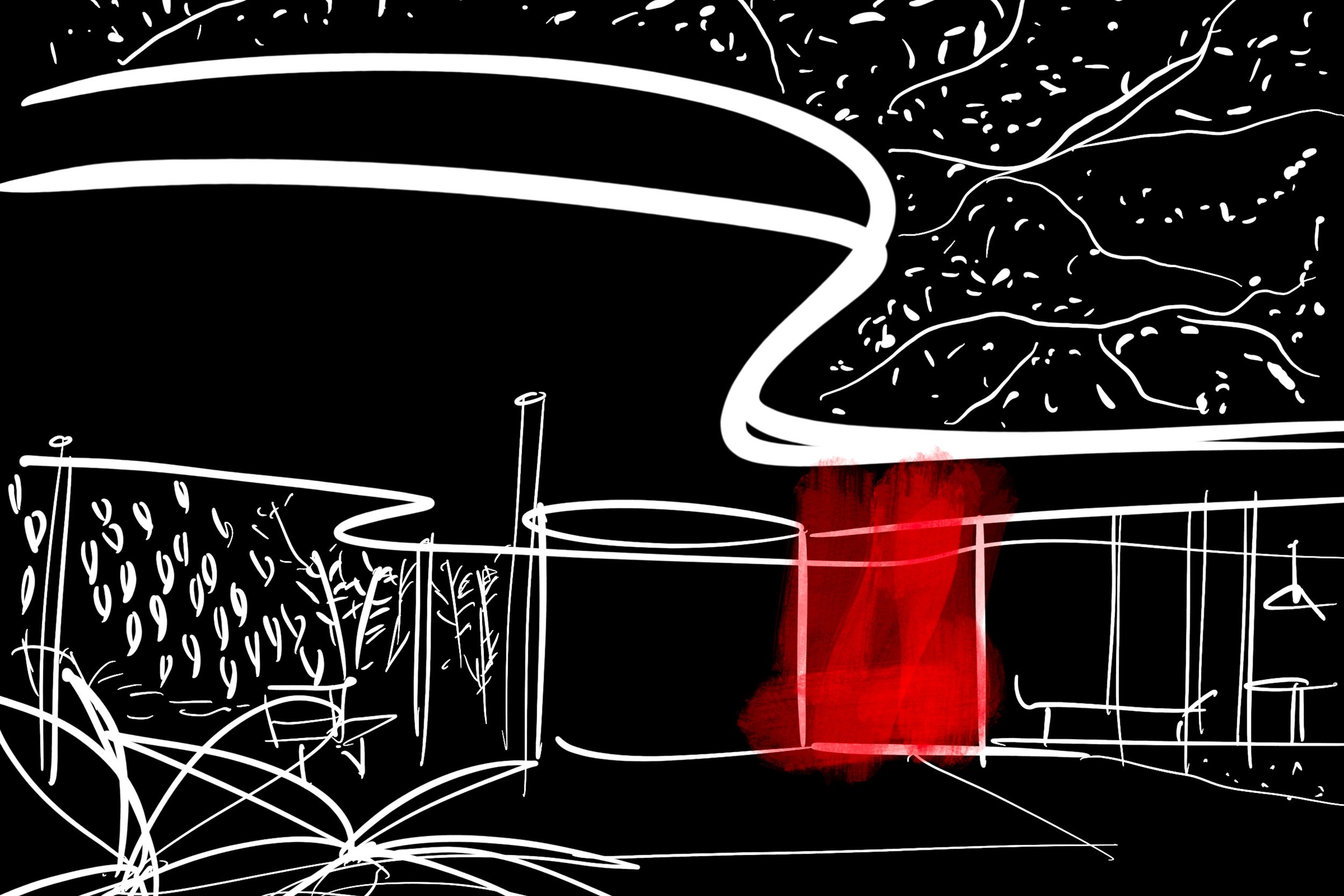
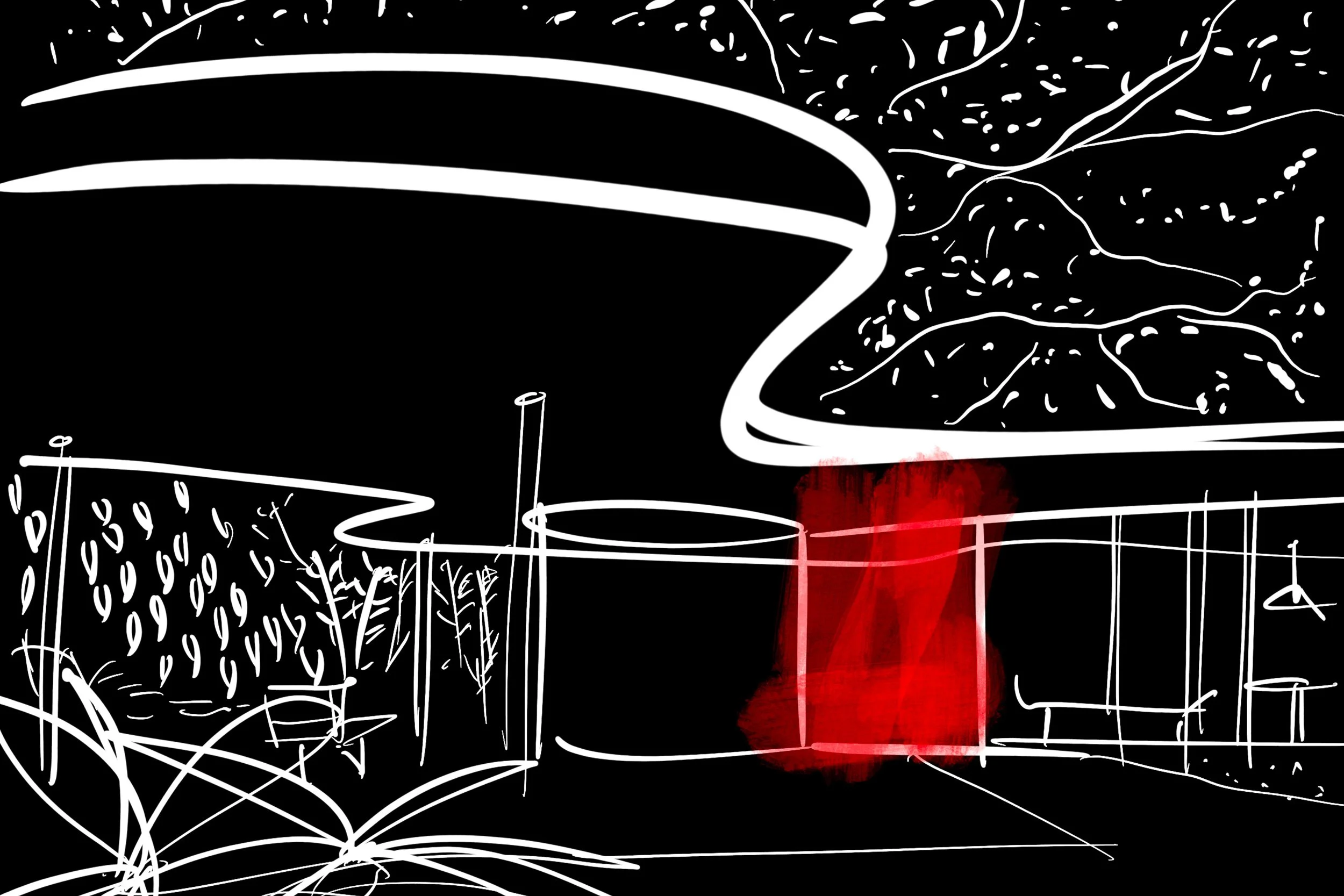
My sketch of Niemeyer’s House at Canoas (Casa Das Canoas), Rio de Janeiro, 1953
Post-World War II disillusionment with the machine as an aesthetic value sparked free-form modernism and the interest in organic architecture. More than a theory, organic architecture is a way of life made possible by a unified composition of site, building, furnishings, and surroundings.
The Principles of Organic Architecture: Lessons from Niemeyer’s House at Canoas
Core principles of organic mid-century modern architecture
The main principles of organic architecture—and of one of its sub-sets known as organic mid-century modern architecture—are building and site, material, shelter, space, proportion and scale, nature, repose. Today—these principles outlined by F.L. Wright and B. Zevi nearly a century ago—are more than ever relevant for contemporary architecture, and at the core of truly sustainable architecture. They stress the necessity for a building to grow out of the landscape, or the urban context, as naturally as trees; the need to use materials minimally, using their inherent texture, color and strength as decoration; the importance of safety and privacy; the notion that nature is the master and from her we derive proportion and scale creating an appropriate setting for human life. An architecture with these qualities—with at its core the user’s spiritual, psychological, and materialistic necessities— is very likely to be loved, withstanding the test of time remaining in use for generations. Therefore, escaping demolition and conserving resources—ultimately becoming the real model for sustainability.
The elusive nature of architectural space
Let’s now turn to the concept of space on which rely all the other principles we just outlined. Space has an elusive and free nature. It can be seen only when confined within the structure of which is the negative image when read in plan or section. Space is truly appreciated through the fourth dimension of time while moving from one point to another. The experience of quality and beautiful space inspires the user and, if only momentarily, lifts humanity out of the dismal grind of existence.
So, when it comes to the creation of space, nature is the master. In fact, it is in her that we observe the principles of harmony and elegant spatial relations. It is in her curves that we find embodied beauty. As A. McRobie points out in his book The Seduction of Curves (Princeton University Press, 2017), “Curves are seductive. These smooth organic lines and surfaces—like those of the human body—appeal to us in an instinctive visceral way that straight lines or the perfect shapes of classic geometry never could.”
Oscar Niemeyer and the sensual curve
These words echo those of Oscar Niemeyer, one of the pioneers of modern architecture. In fact, D. Underwood—in his book Oscar Niemeyer and Brazilian Free-form Modernism (George Braziller, Inc., 1994)—reports that Niemeyer to explain his architecture often said “It is not the right angle that attracts me, nor the straight line, hard and inflexible, created by man. What attracts me is the free and sensual curve—the curve that I find in the mountains of my country, in the sinuous curves of its rivers, in the body of the beloved woman. The entire universe is made of curves—the curved universe of Einstein.”
Striving to design in harmony with nature, Niemeyer—in House at Canoas (Casa Das Canoas), Rio de Janeiro, 1953—succeeded in articulating in a cohesive language the principles of organic architecture integrating them with elements of rationalism—reminiscent of the Bauhaus ribbons of glass—when satisfying the function-driven requirements of seamless indoor-outdoor flow as part of the project program.
Describing the project Niemeyer said, “My concern was to project the residence freely and to adapt it to the unevenness of the ground without modification, making it into curves, so the vegetation could enter them without separation.”
Inside House at Canoas: shelter, complexity, and contradiction
House at Canoas embodies contradiction. Through its veins flows the blood of openness and transparency—main floor—reclusiveness and mass on the lower level. But, overall, coherence with organic architecture is very rapidly intercepted. In fact, the sinuous concrete canopy—sheltering the entire main floor—could be a contour of the surrounding orology while the glass walls allow nature to penetrate the volume. On the lower level—where the bedrooms are—the space is perceived as more enclosed contributing to a sense of safety while sleeping, when humans are the most vulnerable. In fact, downstairs bedrooms have only small windows piercing the massive walls. Wilderness is still perceived through them but kept at bay by the mass of the structure. The residence is perceived as a shelter, a safe point of observation from which one contemplates and is enriched by natural beauty. Nature defines the boundaries of the house: jungle on three sides, and—downhill in the distance—the sea with the bay.
The Situationist stage and landscape integration
This apparently utopian interpretation of domestic architecture is firmly anchored to the ground by a massive native granite boulder that penetrates both levels while leaping outdoors to become an integral part of the pool. The boulder is the pivoting point of the entire spatial composition and a prime example of a Surrealist natural presence. But the main floor—with its fluid space of stone, water, and vegetation—is also a Situationist stage for a domestic Dérive, a framework for life to take place in entire freedom. The horizontal surfaces flow seamlessly indoor-outdoor protected from the harsh sun by the deep overhang of the sinuous concrete canopy. Because of its fluidity, the main floor is in flux and malleable embracing freedom of use and movement, almost morphing into the open public space of a square.
While moving through the residence, episodes of beauty are experienced. Voluptuous sculptures by Alfredo Ceschiatti interact with the sinuosity of the glass walls and landscape—designed by Roberto Burle Marx. A grand piano is surprisingly found outdoors but still protected by the canopy overhang, and the tropical landscape seeping through the glass becomes Niemeyer’s interior designer as pointed out by D. Underwood.
Because of the radicality and clarity of the design, House at Canoas is tangent to R. Venturi’s vision expressed in his book Complexity and Contradiction in Architecture (MOMA, New York, 1966). As V. Scully elaborates in the book introduction, embracing complexity and contradiction in architecture is rigorously pluralistic and phenomenological in its method. It means to embrace the ambiguity, the surprise. Through movement in space we discover, making going about life bearable.
Ultimately, the creation of architectural space is a spiritual act. It embodies poetry and imagination. A way to achieve integration with the universe.
Liminal Space
Richard Serra – Hitchcock, and Isamu Noguchi – Galvanized Steel Sculptures exhibition currently on view at Gemini G.E.L. (through November 2024, Los Angeles, CA) is a feast for the eye. For several reasons, and not all apparent. The works on view explore a very specific space: the liminal space, the space at the edge.
An exhibit praising light and shadow.
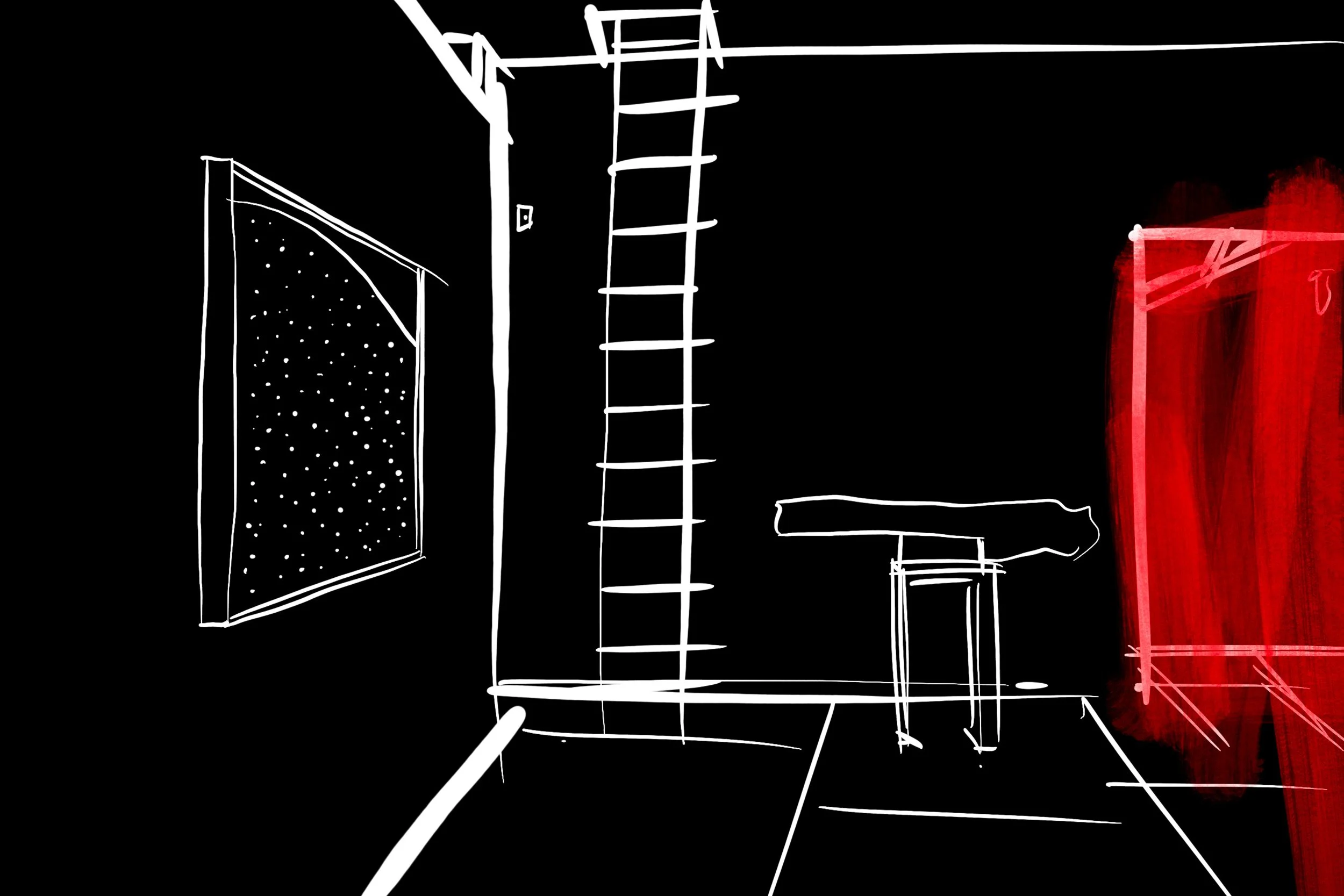
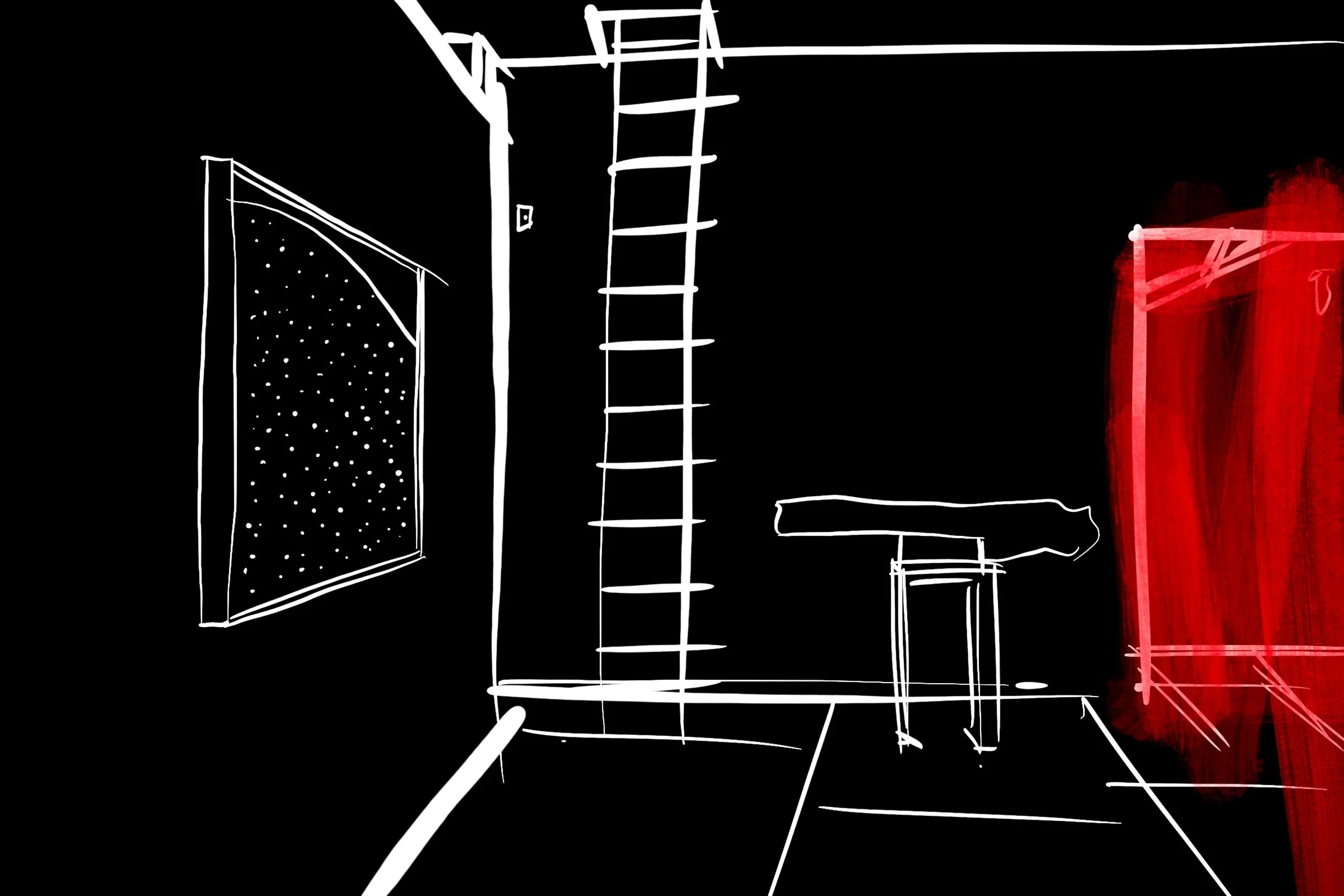
My sketch of the exhibition, second-floor landing
Richard Serra & Isamu Noguchi at Gemini G.E.L.: Art, Space, and the Liminal Threshold
An architectural prelude: Frank Gehry’s Gemini G.E.L. space
Richard Serra – Hitchcock, and Isamu Noguchi – Galvanized Steel Sculptures exhibition currently on view at Gemini G.E.L. (through November 2024, Los Angeles, CA) is a feast for the eye. For several reasons, and not all apparent.
The show unfolds like clockwork through Frank Gehry architecture. Climbing the slightly off-axis staircase with its rhythmic shadows—cast by the exposed wood structure—seems to prime the viewer for what would soon unfold upstairs.
The second-floor landing is very much the vestibule of a shrine where light and shadow are praised by the works of Serra and Noguchi.
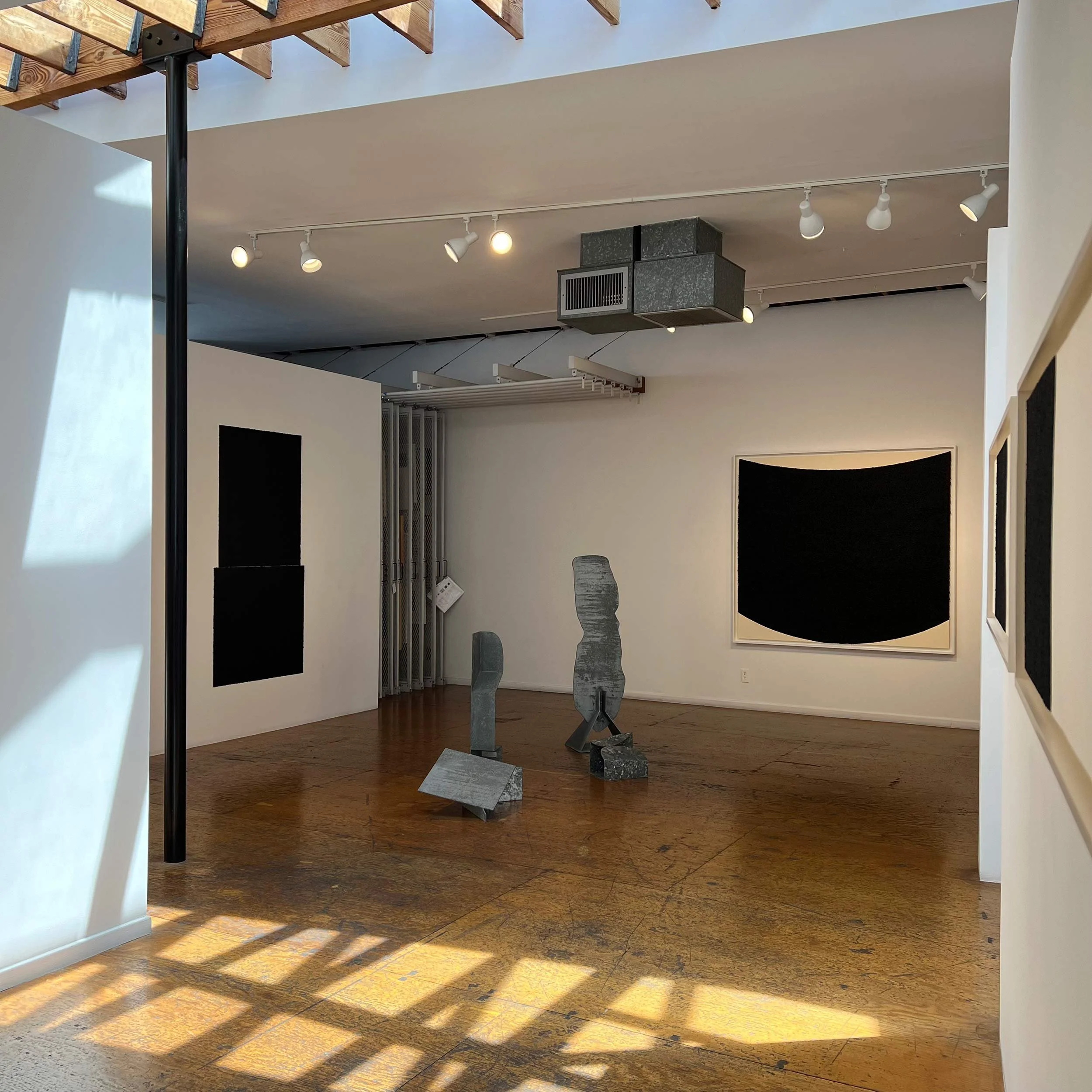
View of the exhibition, second floor
Exploring the liminal space: the absolute edge
Both artists are concerned with space. Through sculptural drawings—Serra— and steel sculptures—Noguchi—a very specific space is explored: the liminal space, the space at the edge.
Reality is observed while looking with one eye closed. Like we playfully do when we reduce the subject to its 2-dimensional essence reading its volume as a cut-out, as the shadow cast by its body.
The works on view are about cutting. The subject embodies an edge, an absolute edge for Serra, that helps us better interpret reality. As the contemporary philosopher D. G. Leahy articulates in the Thinking Now Occurring: where is the point of contact with the world within the world? The meshing takes place at the edge: in the case of the universe as a whole, it takes place at the absolute edge, the infinitely shared edge.
The micro and macro cuts of Noguchi and Serra
Noguchi is concerned with the edge of nature closer to us at a micro-scale, so to speak. A plasma torch cuts through the sheet steel evoking the organic curves of plants, animals, rocks, and sky. On the other hand, Serra simulates the cut on handmade Japanese paper using the stark contrast between the soft-white background and the black fields of heavily textured oil stick. Serra enacts the cosmic edge, the macro edge, the infinitely shared edge.
In Noguchi’s galvanized steel works, light is reflected or blocked—in Sparrow it is only in the shadow cast by the sculpture that we intercept the bird silhouette—while, in Serra’s gravitational fields on washi paper, light is absorbed by the thick solid-lava-like texture vaporizing the vision in pure geometry. Both reach lyrical levels turning artmaking into an essentially spiritual practice. The works are pagan icons, secular prayers, ex-votos, offerings to the black-hole-sun of the surreal landscape sung by Chris Cornell of Soundgarden.
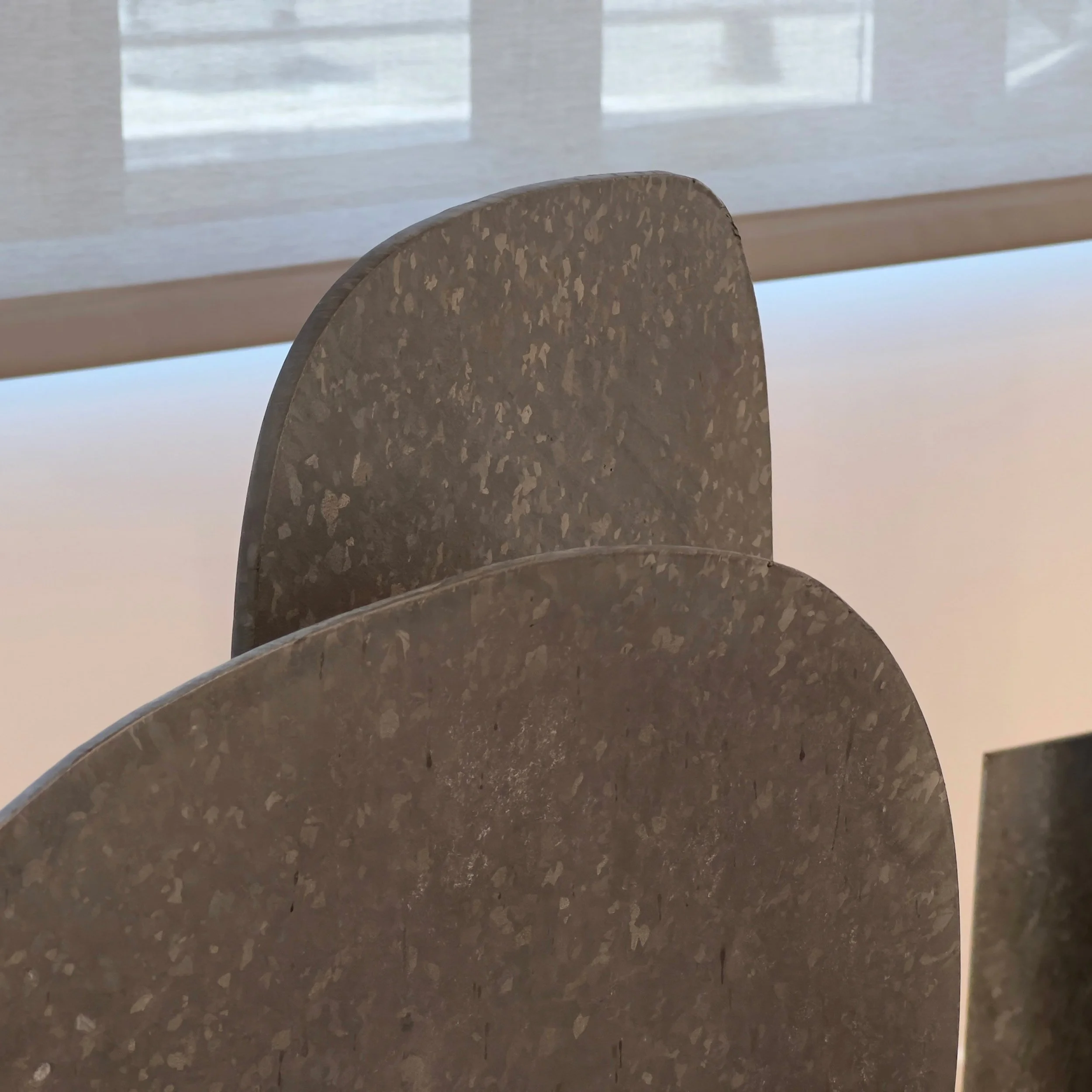
Isamu Noguchi, Kaki-Persimmons, 1983. Galvanized steel sculpture (detail)
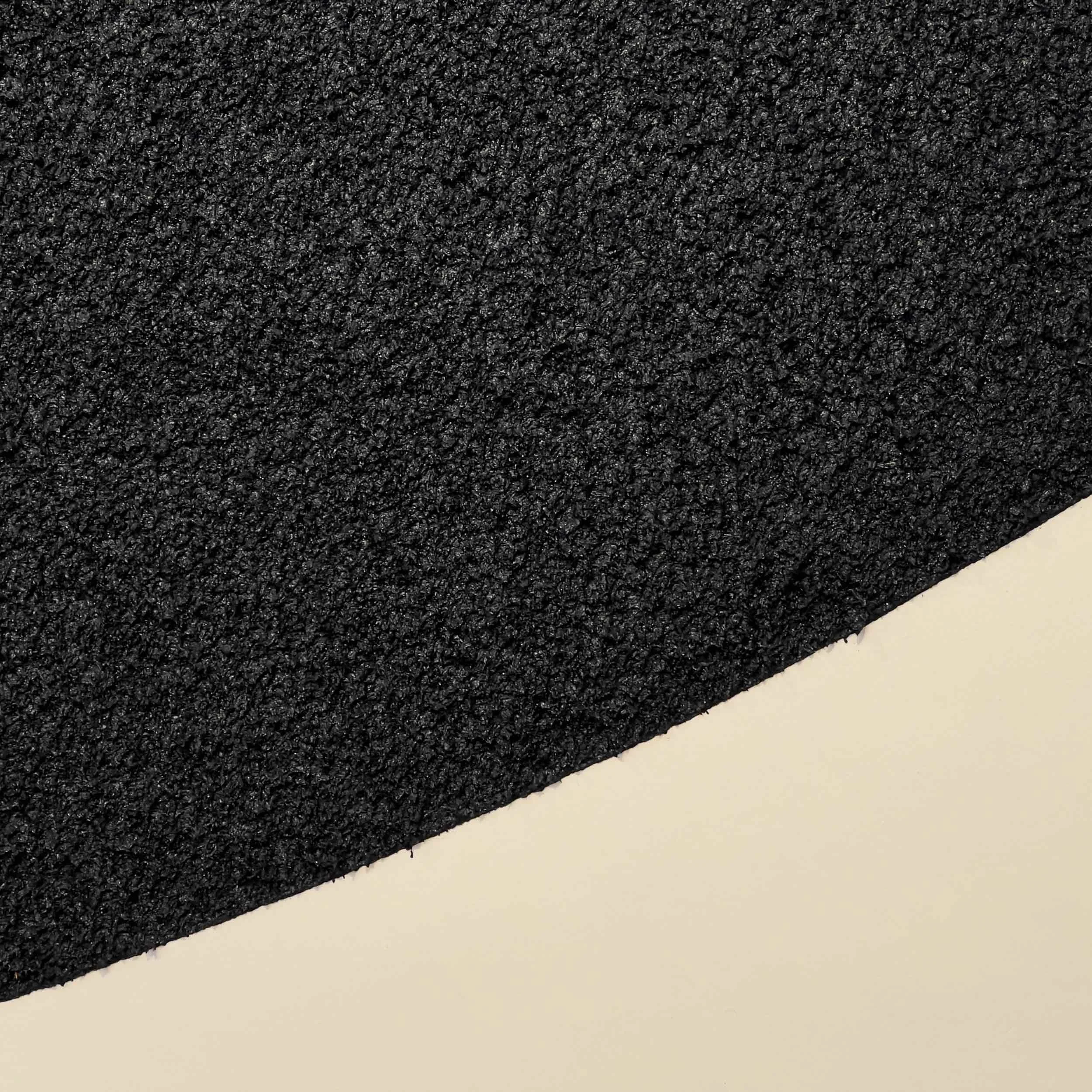
Richard Serra, Hitchcock series, 2024. 3-color oil stick and silica (detail)
Gehry's off-axis courtyard as an architectural interstice
As mentioned earlier, a staircase between the main buildings leads to the upper gallery. The staircase is off-axis. It aligns with the micro-shift of an imaginary film still. It may be perceived out of context and surprisingly placed at the edge of the structure. It gives a sense of temporariness. We could be indoors or outdoors. Climbing it—or standing underneath it—we are pleasantly disoriented as if we were part of a situationist Dérive.
The space of the courtyard, between the two buildings, is at once compressed and expanded by the misaligned stairs. But it is by this very micro-shift of its axis and unexpected placement, that Gehry can generate a successful liminal space. In fact, the courtyard is in a transitional state, it is in-flux. It is also an absolute edge and an interstice. The architectural volume open to the sky is a threshold and a surprise—a place between what we are and what we choose to become.
The gallery courtyard interstice is the equivalent of Noguchi-Serra’s cuts. It is by introducing discontinuity, and by deliberately standing on that liminal threshold, that we truly embrace the otherness letting creative thinking occur now.
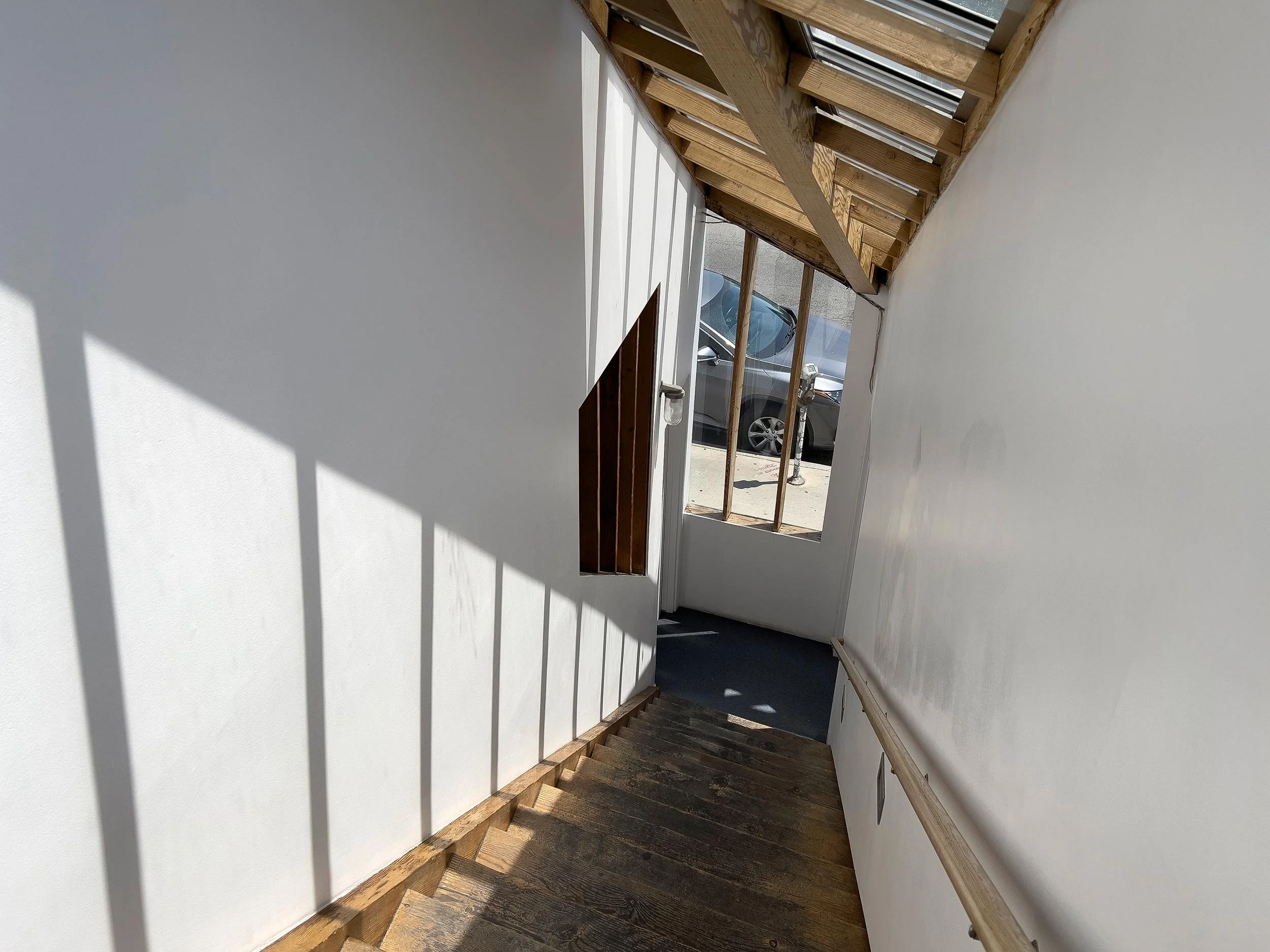
Gemini G.E.L. gallery, Gehry’s staircase connecting the street level to the second floor, 1976-1979
Atoll Residence
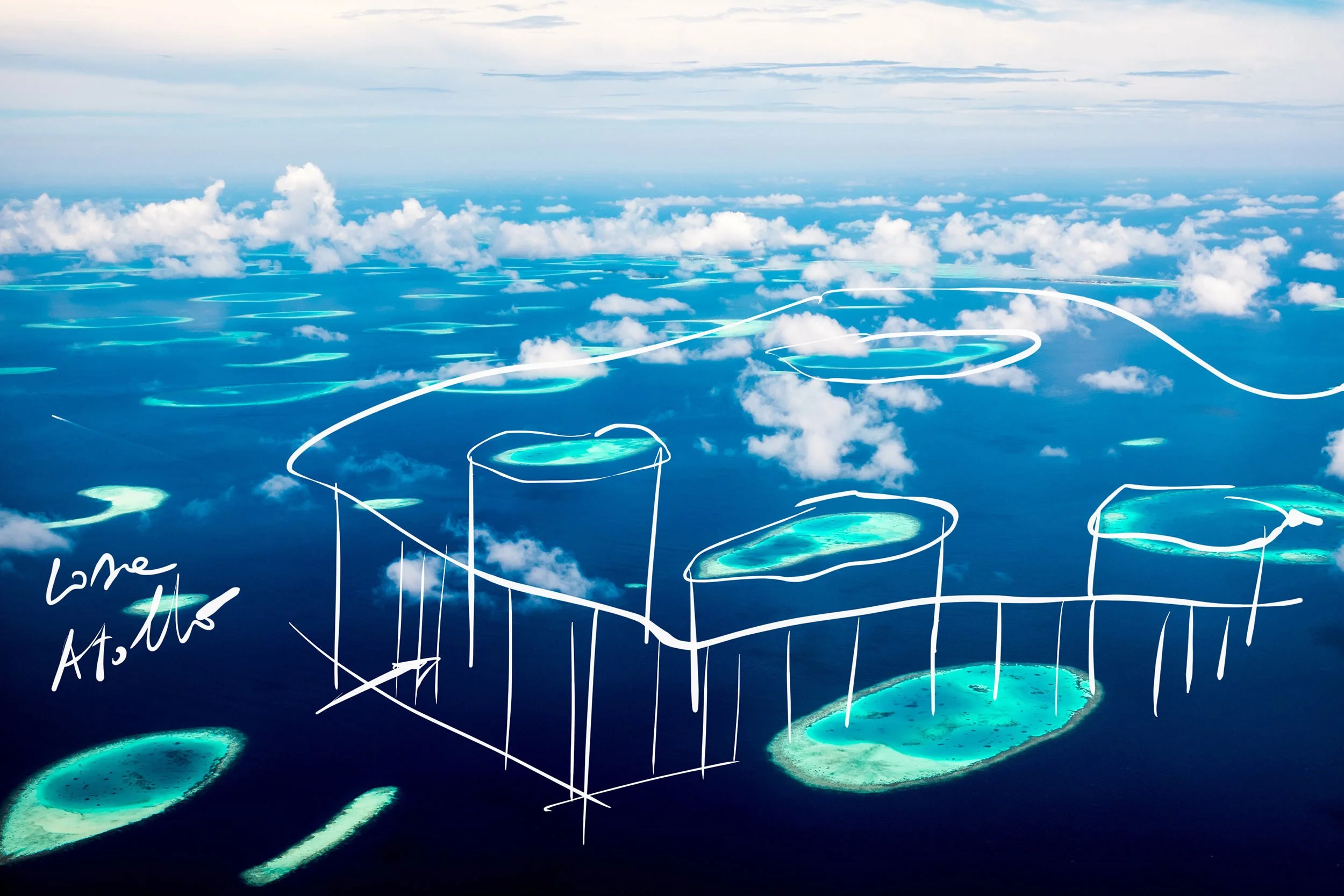
The Atoll Residence: an urban retreat.
Currently in its conceptual phase, the Atoll Residence reimagines the traditional urban retreat through an architectural language of fragmentation and unity.
Reimagining the Urban Retreat Through Conceptual Design
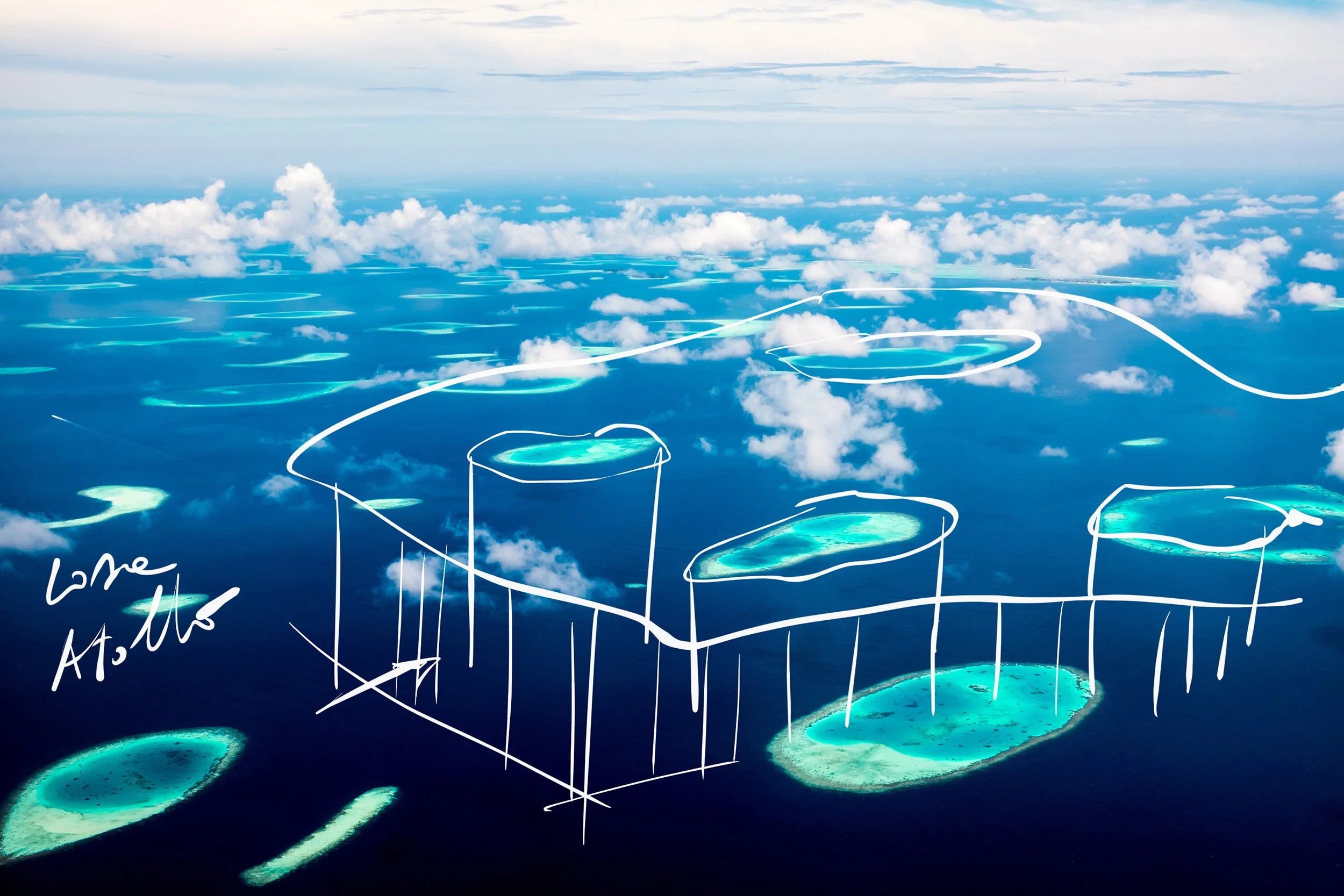
Atoll Residence: conceptual sketch.
Currently in its conceptual phase, the Atoll Residence reimagines the traditional urban retreat through an architectural language of fragmentation and unity. The design is explored physically and digitally: the fluid, winding geometry is first mapped out through a tactile clay maquette and then refined into a precise digital model.
Fluid Interactions and Urban Nature
The residence introduces a bold layout, envisioned as a series of isolated structural islets anchored beneath a single common roof. Instead of dividing the property into rigid zones, the physical tension and negative space between these individual islet-suites generate a dynamic, flowing open area. This protected commons intentionally reimagines the open space concept preventing monotonous expanses devoid of hierarchy or purpose. By substituting aimless square footage with deliberate, pressurized spatial relationships, the design could enable an immediate and visceral connection with the outdoors while restoring a sense of discovery to how the interior space is experienced.
Breaking Planes and Framing the Sky
The Atoll Residence actively challenges the traditional boundaries of horizontal layout design by utilizing vertical movement as the leading force shaping up the experience of the indoor environments. On the upper sundeck level, the sinuous, curving volume of each islet-suite pierces directly through the roof plane to create an intriguing, sculpted morphology. By deliberately breaking the roofline, the design transforms every single room on the lower level into an expansive private skyspace, flooding the urban retreat with shifting natural light and framed, upward views of the sky.
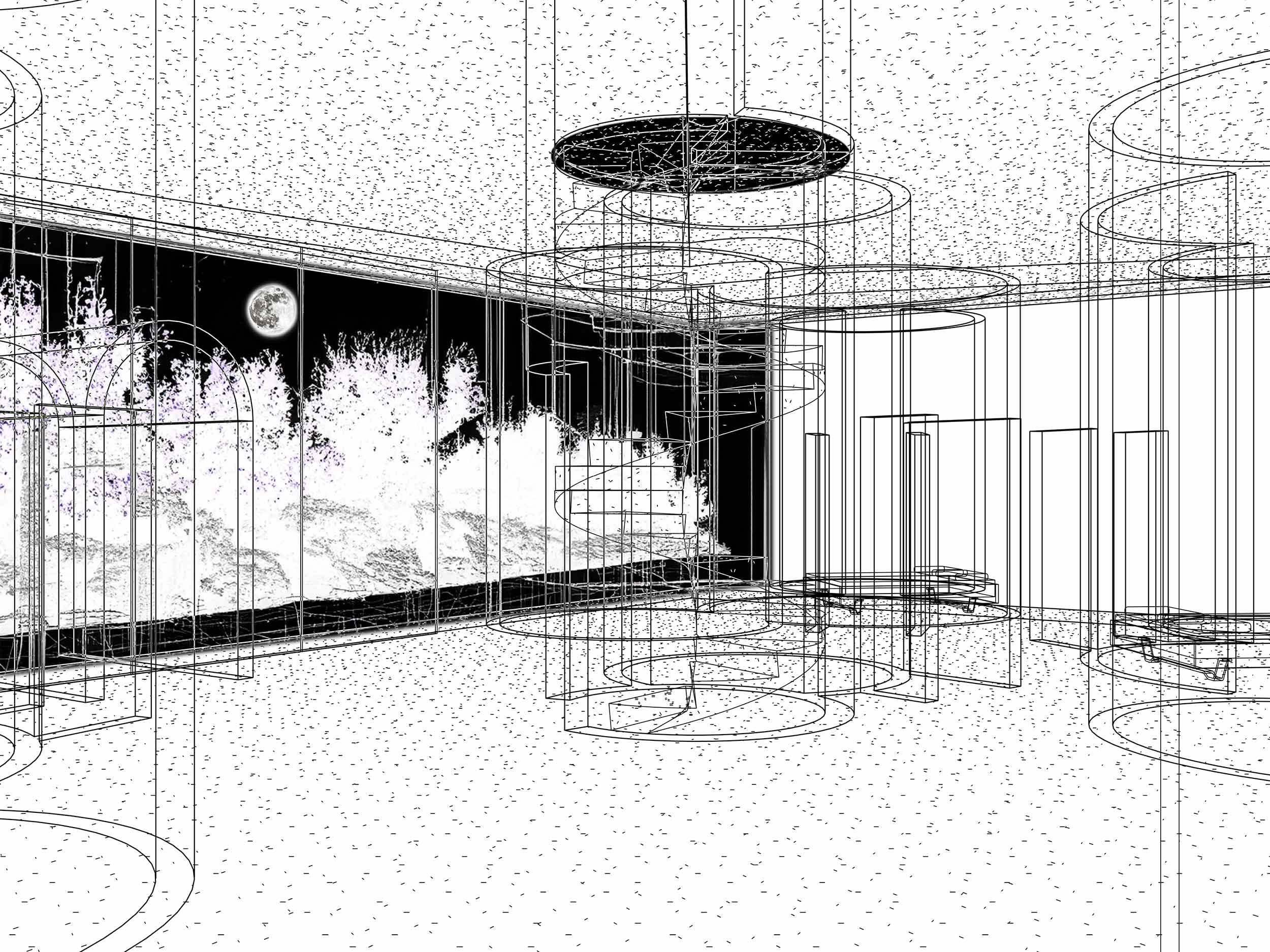
Atoll Residence: conceptual wireframe view of the foyer.
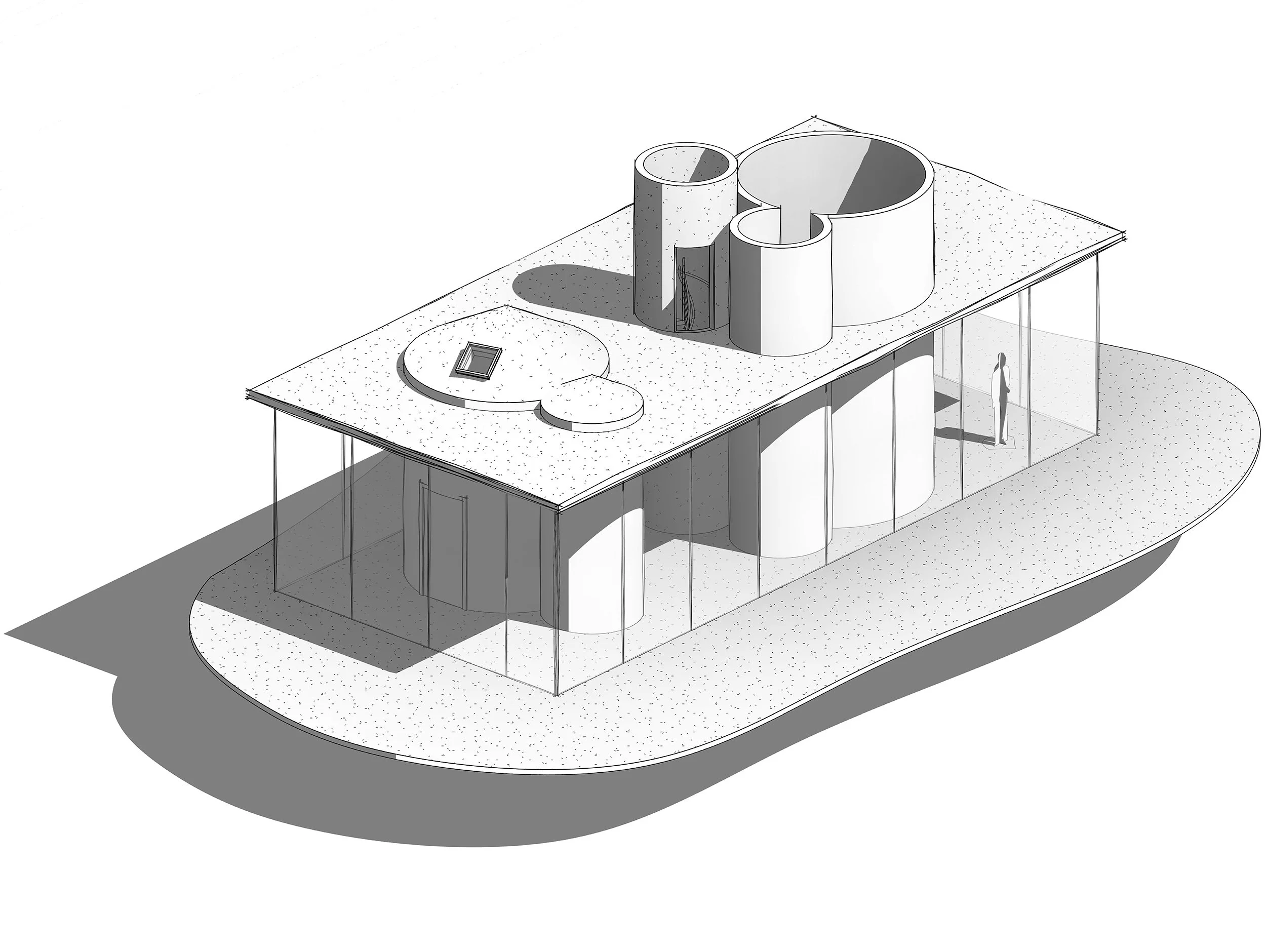
Atoll Residence: conceptual digital model.
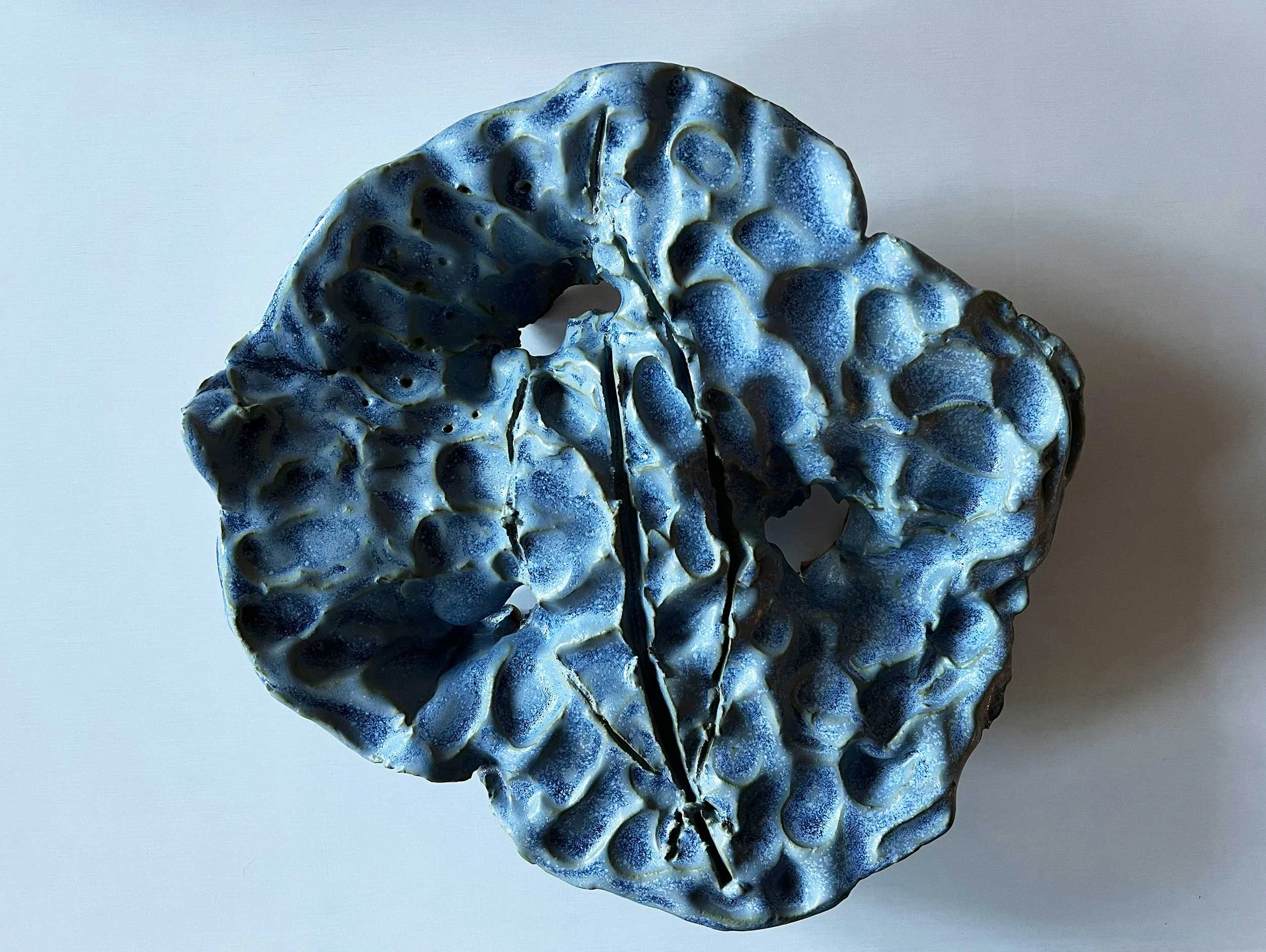
Atoll Residence: conceptual clay maquette.
VoyageLA—Interview
Today we’d like to introduce you to Livio Stabile.
VojageLA: Alright, so thank you so much for sharing your story and insight with our readers. To kick things off, can you tell us a bit about how you got started?
Livio Stabile: My current practice involves art, architecture and construction —not necessarily in that order. In my research I let the three realms cross-pollinate.
Livio Stabile on the Power of Integrated Design and Authentic Sustainability
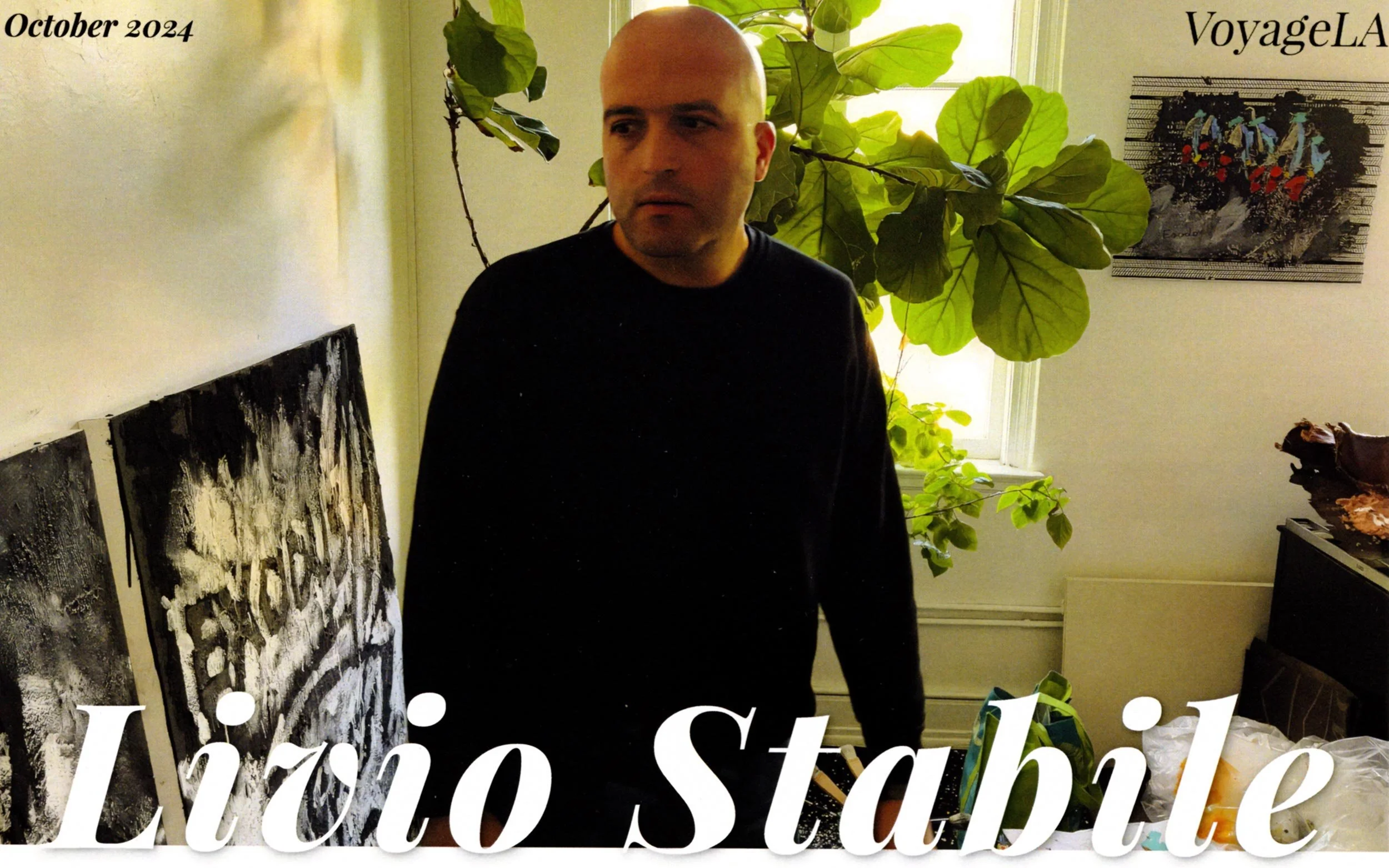
Magazine feature